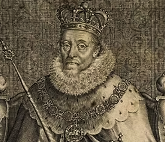
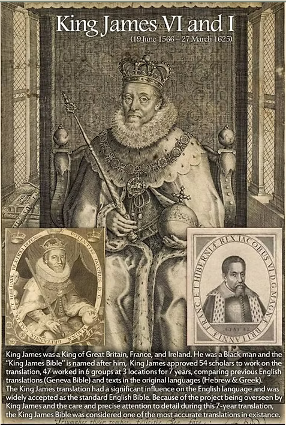
The King James Version ("King James Bible")
and the [homosexual] man behind it:

(see NIV and NASB sections)


King JamesAt least 60 men (MEN, of COURSE!) were directly involved in the translation of the King James Bible (hereinafter KJV).  Most (47) were Translators, while a few were project overseers, revisers and editors. Some served in several roles.  There were 47 translators that were actually approved - out of the 54 allowed for selection.

Who were these men? What were their backgrounds? What did they share? In what ways were they different? They were a diverse group. While some were born in large cities and towns, most were from small villages scattered throughout England. Several were the children of university graduates, most were not. They were sons of mariners, farmers, school teachers, cordwainers (leather merchants), fletchers (makers of bows and arrows), ministers, brewers, tailors, and aristocrats. All were members of the Church of England, but their religious views ran the gamut. Some were ardent Puritans, others staunch defenders of the religious establishment. Some believed in pre-destination and limited salvation as taught by John Calvin, while others believed in self-determination and universal access to heaven as taught by Jacobus Arminius.

All of the Translators were university graduates. Oxford and Cambridge claimed nearly equal numbers of Translators as alumni. All of the Translators except one were ordained Church of England priests. While several of the Translators had traveled to the Continent, only one had ventured to the New World. Most of the Translators were married men (38 of 60) with families. Most of the Translators spent a significant portion of their career associated with their colleges and universities as fellows, involved in teaching and administration. As fellows, they were not allowed to marry. As a result many delayed marriage until they had established themselves in church office away from the university. When the translation commenced in 1604-1605, the majority of the Translators, 22, were in their forties, 16 men were in their thirties, 15 in their fifties, 3 in their sixties and 3 in their twenties.

1 Translator died in his thirties, 6 in their forties, 19 in their fifties, 16 in their sixties, 4 in their seventies, 3 in their eighties and 1 over one hundred.  9 of the Translators died before the KJV was published in 1611.
https://www.lavistachurchofchrist.org/cms/the-king-james-translators-thoughts-on-bible-translations/


"The missing verses"
https://mattdabbs.com/2008/03/20/the-case-of-the-missing-verse-john-54/
I always thought the fact that the NIV has 49 blank verses just made it easier to win a memory verse competition by saying, “Matthew 23:14” then pausing, “Mark 7:16” then pausing, until you have quoted 49 memory verses without having to say a word. Go figure. On a serious note, there have been accusations that the NIV has deleted verses in the New Testament. The insinuation is that the NIV committee did not have a proper respect for the text and that earlier versions of the English Bible are more accurate and faithful to God’s word because they contain these verses. The first thing that we have to understand when coming to this issue is that translation is a difficult job. There are over 3000 Greek manuscripts and fragments of the New Testament of varying age. Each one was hand copied, which leaves room for mistakes and even practical decisions of what to do with what the previous copyist has done. John 5:4 is one of the verses in contention.

The KJV decided to include it because it was in the manuscripts they had at their disposal. The NIV decided to omit it because in the 400 years since the KJV was translated much older manuscripts had surfaced that did not have that verse. Remember, the KJV was translated largely from the Textus Receptus which was a compilation of manuscripts that did not even date prior to 1100 AD.

What happened in the 800 years between the texts the NIV is based on and the texts the KJV is based on? Copying, copying, and more copying. Often a copyist would write an explanation in the margin and some times that explanation would end up in the text. Bruce Metzger (Text of the New Testament, 194) thinks that is exactly what happened in the case of John 5:4. Why? For several reasons (listed in Metzger’s textual commentary Edition 3, 209):
1 – Because the earliest manuscripts don’t contain it. Why not? Did they omit this verse just like the NIV? Of course not. They don’t contain the verse because the manuscripts they were copied from didn’t have it and the ones before them didn’t have it because the original didn’t have it. It doesn’t start appearing in manuscripts for at least 500 years When no manuscript before 500 AD has a verse you can be fairly certain that it was added in from a marginal note, from a copying error, or due to the copyist remembering that verse in another gospel and accidentally harmonizing them in his head and copying it wrong (such is the case of a few other “missing verses”). But once it is added it then gets copied over and over and from that point on may appear original to the next copyist
2 – Multiple Greek manuscripts copied after 900 AD have a mark showing that they thought the verse was questionable but they included it because it was in the manuscript they were copying from.
3 – This verse has multiple words that John doesn’t use anywhere else = out of character
4 – This verse has a larger number of textual variants = there are many versions of this text in many different Greek manuscripts which points to it being very questionable as to what was original if it even was original.

With all that weight against it the NIV decided not to include that verse in its translation. Did the NIV delete the verse from the inspired word of God? They didn’t delete it if it wasn’t there to begin with. It may seem like a verse was removed because previous English versions like the KJV included it because it was in the manuscripts they used to translate from. People read it for 400 years in English and became accustomed to it. So when they spot it missing from the NIV eyebrows go up and accusations begin to fly. So it probably wasn’t so much that the NIV deleted something or that the KJV added something. The problem was the texts the KJV was translated from were simply not ideal.

Missing verses in the bible:
https://zondervanacademic.com/blog/the-missing-17-verses-in-the-bible-mondays-with-mounce
I call them the “17 Added Verses” since there is no question they were added after the original authors wrote. I know there is a lot of graceless talk out there about “corrupted” texts that “omit” parts of the Bible, but let me emphasize that if it is wrong to drop out words from the Bible (and it is), it is equally wrong to add them in.

The only large passages that were added to the biblical text are the story of the “Woman Caught in Adultery” (John 7:53–8:11), and the longer ending of Mark (16:9–20). Unless you want to handle snakes and drink poison, neither of these passages add anything to our knowledge of the Bible.

The one that causes the most “discussion” (I am being polite using that word) is 1 John 5:7b–8a, since if original it would be the only explicit reference to the Trinity. But the evidence is overwhelming that these words were added centuries after John wrote, and we don’t need them to affirm the doctrine of the Trinity.

https://missingbibleverses.com


The King James Version was not ​a new translation
The title page of the 1611 King James Version Bible has a discraimer: “Newly Translated out of the Originall tongues: & with the former Translations diligently compared and revised.” However, the King James Version was not really a new translation.

The KJV translation committees were instructed to follow the Bishops’ Bible as much as possible. The Bishops’ Bible (1568) followed the translation of the Great Bible (1539), which was a revision of Matthew’s Bible (1537), which was a revision of the Coverdale Bible (1535) that included Tyndale’s translation. Therefore, much of the 1611 King James Version actually originated with William Tyndale nearly 100 years earlier.

William Tyndale was a brilliant linguist and a superb translator. Many of the phrases in his translation are still in use today: “give up the ghost” (Job 3:11, 13:19), “the powers that be” (Romans 13:1), “my brother’s keeper” (Genesis 4:9), “the salt of the earth” (Matthew 5:13), “fight the good fight” (I Timothy 6:12), “a law unto themselves” (Romans 2:14), and many more.

In many respects the King James Version was a revision of Tyndale’s translation. This is demonstrated by the KJV’s use of  “thou” and “thee” instead of “you.” Alister McGrath says that “a careful study of the court records of the northern English city of Durham suggests that ‘you’ had replaced ‘thou’ as the normal form of address in spoken English by about 1575,” thirty-five years before James’s new translation.

The King James Version was NOT ​a new translation
https://www.storyofbible.com/the-king-james-version-was-not-a-new-translation.html

In answering critics, the translators of the King James Bible defended the making of translations in general. They said, “Now to the latter we answer; that we do not deny, nay we affirm and avow, that the very meanest translation of the Bible in English, set forth by men of our profession, (for we have seen none of theirs of the whole Bible as yet) containeth the word of God, nay, is the word of God.” They were not claiming that the KJV was the only proper translation, but were wanting to improve upon what was already available (e.g., the Bishop’s Bible, as the KJV was not the first Bible in English).

They further state: “No cause therefore why the word translated should be denied to be the word, or forbidden to be current, notwithstanding that some imperfections and blemishes may be noted in the setting forth of it. For whatever was perfect under the Sun, where Apostles or Apostolic men, that is, men endued with an extraordinary measure of God's spirit, and privileged with the privilege of infallibility, had not their hand?”

They defended the idea that translations were necessary and they should not be forbidden “to be current,” even if there are some imperfections. They saw value in updating where needed, and this is one reason why newer translations today should have a seat at the table.

They defended the changes they were making: “Yet before we end, we must answer a third cavil and objection of theirs against us, for altering and amending our Translations so oft; wherein truly they deal hardly, and strangely with us. For to whomever was it imputed for a fault (by such as were wise) to go over that which he had done, and to amend it where he saw cause?”

Later, they write, “But the difference that appeareth between our Translations, and our often correcting of them, is the thing that we are specially charged with; let us see therefore whether they themselves be without fault this way, (if it be to be counted a fault, to correct) and whether they be fit men to throw stones at us…”

In stating their purpose, they say this: “But it is high time to leave them, and to show in brief what we proposed to ourselves, and what course we held in this our perusal and survey of the Bible. Truly (good Christian Reader) we never thought from the beginning, that we should need to make a new Translation, nor yet to make of a bad one a good one, (for then the imputation of Sixtus had been true in some sort, that our people had been fed with gall of Dragons instead of wine, with whey instead of milk:) but to make a good one better, or out of many good ones, one principal good one, not justly to be excepted against; that hath been our endeavor, that our mark.”

They say, “We desire that the Scripture may speak like itself, as in the language of Canaan, that it may be understood even of the very vulgar.”

They were not claiming perfection, and they were not claiming this to be the one and only final translation, never to be touched again. They saw value in translations for reaching the common people.
https://kingjamesbibletranslators.org/bios/

DIE-HARD KJers - they don't want to stray from "the foundation" ... yet BY DEFINITION, they are PROTESTANTS!!   They are protesting against the foundations!!   Doest thou knowest not this, brethern??


There wece 13 months in King James translation

13 months in the King James original bible


Image

King James - personally

What most people don't know (they just aren't aware):  The blue-eyed, skinny/frail "Jesus"  that we have on our stained glass Church windows and our crucifixes - is not the real Jesus.  King James - the one who had the Bible translated into English (well, OLD English:  doest thou understandest?) - also was such an "ego-head" that he had his image painted - as "Jesus".  A fun fact:  King James also made the Roman system - redone with HIS body:  feet, miles, inch. And I'll close with King James after this little-known fact: King James sold Irish women and children - as SLAVES.  Go ahead, look it up:
https://swisscows.com/web?query=king james sold irish as slaves

WATCH THIS VIDEO:
https://youtu.be/FjfvtvmgT3s
King James changed the original text of The Bible to control the English People & hunt Witches.  Here’s the story of why King James omitted some text and added passages that were never in the original scripture:
https://medium.com/@chrissiemassey1023/king-james-changed-the-original-text-of-the-bible-to-control-the-english-people-hunt-witches-c8284564d8b0

NOTE to all of those KJV lovers out there: All the Jews and Pharisees  _thought_  they "had all the answers" (as YOU think now!) - but Yeshua ("Jesus" - his original Hebrew name is Yeshua) came to show them that they did not.  We are the same now as those Pharisees ... and using a horrible Dictator's translation.  A quick closing note:  "Kings and Kingdoms" were all added by KJ - he added all the "kingly" things, to show that "Kingdoms" were a *good* thing.  We all know that any Dictator/King is  not a good thing.  The Greek for "King of Kings" actually means "Master of   to reign/ruler" [see full disclosure below].  Here is some history on the King James you all love so much:

Although the title page of The King James Bible boasted that it was “newly translated out of the original tongues,” the work was actually a revision of The Bishopʼs Bible of 1568, which was a revision of The Great Bible of 1539, which was itself based on three previous English translations from the early 1500s. So, the men who produced the King James Bible not only inherited some of the errors made by previous English translators, but invented some of their own.

Desiderius Erasmus was a “Christian humanist” who collected Greek (and Latin) New Testament manuscripts and compared and edited them, verse by verse, selecting what he considered to be the best variant passages, until he had compiled what came to be known as the “textus receptus.” Early English translations of the Bible, like those mentioned above, were based on his “textus receptus.” Erasmus was also a monk whom some historians believe engaged in homosexual activities.

Remember:  King James - well ... was a *King* - not "elected".  He lived in riches and excess .... while his country people toiled, and lived in poverty.  Yes, same with Solomon, David ... all Kings.   Many get *really* mad - when I dare say anything about Solomon.   1) "worship" means "to hold in high esteem, especially to worship", and     2) King solomon was badly cursed by God - mainly because he worshipped Baal later, and he married foreign wives.  Obviously a sex addict, his "wisdom" was temporary, and it doesn't take much wisdom - to throw your children into an inferno (he threw his female children - of which he had hundreds - into red-hot Baal!)   _Now_ do you think he's so great?   Me either.   If *God* cursed him, I can have a grudge against him too.

We all have a thing called "confirmation bias" (and eisegesis), and it makes us want to believe what suits our narrative, and "toss" what doesn't.  *I* say* : facts don't have feelings.  Especially since many Christians - use "wine" as an excuse to "get a buzz".  "Fruit of the vine" could mean raw fruit, grape (etc) juice, or yes, it could mean fermented, but that would toss the "Be ye not drunk with wine" out the window.

Some history of King James:
King James I inherited a mess when he ascended to the throne of England. The Church of England, Puritans and Catholics were at odds with each other. One big problem was the previous translation of the Bible. James convened the Hampton Court Conference, which would tackle some of the problems of the earlier translations. The translation work began in 1604. It took 47 scholars 5 years to complete the work (published in 1611). The King James Bible is one of the most important books in English culture.

King James’ England
To understand the turmoil that England was in when James ascended to the throne, you almost have to go back to King Henry VIII, best known for having six wives. King Henry’s first marriage was to Catharine of Aragon, his brother’s widow. It was this marriage that led to a disagreement with the Pope. Henry wanted the marriage annulled. When the Pope did not grant the annulment, Henry separated from the Catholic Church, naming himself Supreme Head of the Church of England. This started the English Reformation. Henry might have had six wives, but he only had three living offspring: Mary, Edward and Elizabeth.

As the only male heir, Edward took precedence over his sisters. Edward was nine years old when Henry died. During Edward’s reign, Protestantism was established in England. His council of regents imposed compulsory services in English and abolished the Mass. He never really ruled in his own right, because he died at the age of 15, but he did change the succession by naming Lady Jane Grey as his successor. This was to prevent England from returning to Catholicism. Lady Jane only reigned for nine short days before Mary, Edward’s sister and rightful heir, deposed Jane.

Queen Mary attempted to reverse the English Reformation. She would be known as Bloody Mary. She only reigned for five years, but during that time had 280 people burned at the stake for being a religious dissenter. Another 800 rich Protestants chose to leave England in exile. Mary even imprisoned her sister, Elizabeth, for suspicion of supporting the Protestant rebels. In the end, Elizabeth succeeded Mary.

Elizabeth I was more religiously tolerant than her brother or sister, but Elizabeth is largely responsible for the establishment of the Anglican Church. The Pope declared Elizabeth illegitimate. The Catholics in Ireland, subject to Elizabeth, turned hostile and routinely defied her authority, which led to turmoil in the kingdom.

Elizabeth did not marry, nor did she have children. She refused to name a successor, which made it difficult for her government to prepare for a smooth transition. James VI of Scotland had a strong claim, but Elizabeth did not outwardly recognize him. Still, he was proclaimed James I of England on her death. Although England was politically and religiously stable when Elizabeth died, there were concerns that James would throw England back into turmoil.

See my section on "King James was gay/King James was a homosexual".


Image

King James Rules:
James ascended to the throne in 1603. He inherited an England that was in debt and religious turmoil. Many of his subjects were Roman Catholics, concerned about persecution. On the other hand, James was seeking a Spanish wife for his son, which concerned the Protestants, who feared that would bring a revival of Catholic power.

Still, James moved forward with the translation of the Bible. This version was to conform to the episcopal structure of the Church of England. Considering the state of England when James came into power, it’s astounding that he was able to bring 47 scholars together to complete the translation.

Published in 1611 at the behest of King James I of England. It is likely the most famous translation of the bible and was the standard English Bible for nearly 3 centuries. Many people think that it’s so named because James had a hand in writing it, but that’s not the case. As king, James was also the head of the Church of England, and he had to approve of the new English translation of the Bible, which was also dedicated to him.

So if James didn’t write it, who did? To begin with, there’s no single author. One individual - Richard Bancroft, the archbishop of Canterbury - was notable for having the role of overseer of the project, something akin to a modern editor of a collection of short stories. The actual translating (writing) of the KJV was done by a committee of 47 scholars and clergymen over the course of many years. So we cannot say for certain which individual wrote a given passage.

The other translations available were the Tyndale version and the Geneva Bible. King James argued that "ekklesia" in Matthew 16:18 (which referred to Christ building His "congregation" in the Tyndale translation) should be translated to "church." And James didn't like the Geneva Bible's translation of Matthew 2:20 which seemed to brand all kings as tyrants: (most are!)
19  When Herode was deed: beholde an angell of ye Lorde appered in a dreame to Ioseph in Egypte
20  sayinge: arise and take ye chylde and his mother and go into ye londe of Israel. For they are deed which sought ye chyldes life.
21 The he arose vp and toke ye chylde and his mother and cam into the londe of Israhel.
(see more translations here on my other page, but see the link at: https://biblehub.com/tyndale/matthew/2.htm)


NOTE: Queen Mary was the horribly evil Queen of England - she had well over 300 educated people burned at the stake - including women - for reading the Bible.   William Tyndale (one of those burned) held-out until his last breath - and prayed loudly "Lord, please open the King's eyes!!" before he was hanged, then burned.

God answered his prayer - the next King: Henry the 8 ... finally authorized the Bible to be printed.   And NO - King James was NOT the first Bible to be authorized.  It was William Tyndale's - after he was burned at the stake for Translating it!   Four years later, it was authorized and King James drew heavily on it.   See The Forbidden Book on my documentaries page.
The History of The Canonized books (“The Bible”) - from the 10 commandments - to the Catholic crusades (murder) and burning anyone who reads or produces any English translation.  We can’t IMAGINE that now, but William Tyndall and many others - were burned for making it available it English.  The only legal way was in LATIN.  And you thought YOU had it rough - because people ‘snub” you for telling about Jesus.
https://www.youtube.com/watch?v=ntSFq2IZw4o

Did you know that during the period of A.D. 100 to 400, the Bible had been translated into nearly 500 languages? Did you also know that from A.D. 400 to 500 it had been reduced to just one language? A language only known to the clergy and the educated. As a result of the Bible becoming the ""Forbidden Book"" the dark ages were marked by superstition and ignorance. Confusion controlled the minds of the masses.

However, by God's sovereign hand, He called a few brave men to preserve and restore the Bible to the people. John Wycliffe, the brilliant century 14 Oxford scholar, translated the Bible from Latin into English in order to enlighten the masses oppressed through ignorance. His work was so despised by the established church, that Pope Martin V ordered Wycliffe's bones to be dug up and burned.

Martin Luther was one of the few who challenged church authority in century 16, and lived to tell the tale. In exposing the folly of indulgences (paying money to the church in order to obtain favor with God, and Church prostitutes - to make them rich), he revealed what had always been written in scripture, that justification was through faith. William Tyndale was not spared like his friend Luther. Tyndale spent the last 500 days of his life in a cold castle dungeon. He was then tied to a stake, strangled and burned. His crime?... printing Bibles in the English language!

Discover the fascinating story behind the preservation of the Bible, and the extreme risks many took - including Apos Paul, the apostles, and disciples …. and today, many taking it overseas.


Image

In 1604, at the Hampton Court Conference, James authorized theologians to start a new translation for all English-speaking parishes. 47 scholars were convened, worked for 7 years, and produced The King James Authorized Version of the Bible in 1611. (The first English translation of the Bible, the Tyndale, was produced just 85 years earlier).

Though his translation of the Bible remains his most famous legacy, James also approved the flag for Great Britain, sponsored William Shakespeare as a playwright (even though his plays were vulgar and about murder), expanded "trade" with India (this was the SLAVE TRADE!!), and was the namesake for the first permanent colony in the New World (Jamestown).

James was widely unpopular and made many enemies in Parliament. He may have been bisexual (hence his love for the famous homosexual William Shakespeare), but he was certainly known to be homosexual. He opposed the Pope's power and wrote against Catholicism's influence in politics (but it's fine for HIM to be!). That, combined with his holding fast to the idea that Kings were only responsible only to God (the divine right of kings) - and not The People - led to an assassination attempt. In 1605 a group of Catholics attempted to kill James, his wife, his son, and Parliament. "The Gunpowder Plot", now remembered as "Guy Fawkes Day", failed.
https://en.wikipedia.org/wiki/Gunpowder_Plot
https://www.britannica.com/event/Gunpowder-Plot
https://www.history.com/topics/european-history/gunpowder-plot
https://www.worldhistory.org/Gunpowder_Plot/
https://www.hrp.org.uk/tower-of-london[...]ies/guy-fawkes-and-the-gunpowder-plot/

So, knowing that King James was a Slave Trader, full of himself (a narcissist), and Gay .... read this about the crucifix we all think was "Jesus", but was actually King James:
First, King James was an avid homosexual - usually in love with older men.  Esmé Stewart was the most famous lover.
https://www.factinate.com/people/facts-king-james/


Image

Although the KJV is on it's Edition #7, they are REVISIONS.  They don't want to call them that, but what shall we calleth "Changes"???  "Edition".  This is sugar-coated for "translated version".  They have "updated" the KJV 7 times already.  OK, 2 ways to look at it:
1)  7 times - over 412 years (2023) - is really GOOD.
2)  If you are NOT TO CHANGE it, that's 7 times of CHANGING.
Quick addition:  The ORIGINAL Hebrew and Greek HAVE NOT CHANGED AT ALL - in THOUSANDS of years [duuuh!]

Other reasons I despise that Shakespeare era:
Readability - NASB The New American Standard Bible uses contemporary language and punctuation, the King James version does not, being written almost 400 years ago, and virtually unchanged for about 120 years. The crux of the matter of readability is the difficulty of the Elizabethan English of the KJV, which is laborious to read even for those who are well educated and familiar with the texts, when compared to reading the same texts in the clearly written NASB in it's familiar modern format and natural vocabulary. Other readability issues include the use of quotations and poetic stanzas, small caps for Old Testament quotes in the New Testament, and capitalization of pronouns referring to deity. The NASB also recognizes Greek translations of Hebrew names and translates the names consistently, as opposed to the KJV which gives us multiple names for the same person; for example, the KJV calls Judah, the son of Israel, "Judas" in Matthew 1:2, because that's how it is in Greek. The NASB simply calls him Judah in both the Old and New Testaments; this is simpler to understand and just as accurate.

Quality of language translation
We have since learned a great deal about _ancient_ Greek and Hebrew. Our understanding of Greek has grown significantly, particularly with the discovery that the Greek Bible was in common (Koine) Greek, but our understanding of Hebrew has vastly improved since the crentury 17, during which time the ancient Hebrew was very poorly understood. The NASB clearly benefits from a better understanding of the languages, and presents not only closer translations, but provides notes for certain aspects of translation, as discussed above. When the NASB and KJV differ on the rendering of a text, which is not based on variance in the manuscripts, the NASB is usually more favorable to the original languages. Also, slight variations in words chosen and sentence forms used throughout the NASB reflect our current understanding of Greek, Hebrew, and Aramaic, which has improved dramatically in 400 years.

Quality of manuscripts
The KJV was based on the manuscripts which were few in number, local in geography, and late in date. Archeology has, since the KJV, made almost all important manuscript discoveries - everything from the Dead Sea Scrolls back to the Rosetta Stone, all occur  _after_  the KJV. These new manuscripts can be found in conclusive families, based on history and geography, with standardized variations of content and recognizable progression of modifications. Today's critical texts are very broad based and careful reconstructions of the original writings, and cannot be reasonably discounted out-of-hand, nor can the published arguments of those who would demand the exclusive use of the Textus Receptus be validated, or even accepted as reasonable. To suppose that the much older, much more widely distributed manuscripts, in many languages, which have been discovered over the last 390 years are all corrupted and inferior to the sources for the KJV is incredible, to say the least.


King James is the worst translation. Here's why:
The KJV uses many archaic words no longer in use: words such as jangling, subtil, privily, sunder, and holpen, etc. And it uses archaic expressions and phrases that are unfamiliar to modern readers. For instance, how many people readily understand “Charity vaunteth not itself” (1 Cor. 13:4 KJV)? Or these verses in Job?:

Sample:
Job 15:26-27 KJV.
"He runneth upon him, even on his neck, upon the thick bosses of his bucklers: Because he covereth his face with his fatness, and maketh collops of fat on his flanks”
The original Hebrew:
יָר֣וּץ  בְּצַוָּ֑אר בַּ֝עֲבִ֗י מָֽגִנָּֽיו׃  כִסָּ֣ה פָנָ֣יו בְּחֶלְבֹּ֑ו וַיַּ֖עַשׂ כָֽסֶל׃ פִּימָ֣ה
(yaˇrutz beˇtzavˇvar baˇ'aˇvi maˇginˇnav chisˇsah faˇnav beˇchelˇbov vaiˇyaˇ'as chaˇsel piˇmah)
Direct translation: "to run    neck    thickness    a shield    to cover   face    fat    do    loins/stupidity/confidence    superabundance"

So, does this REALLY sound like the KJV: "Because he covereth his face with his fatness, and maketh collops of fat on his flanks" (answer:  NO.)  Do it RIGHT, Translators - or don't do it at all!

Earlier editions of the KJV also used outdated spelling which can be confusing for some readers (e.g., “sunne” for “sun”). The current edition that is still commonly used has “an hungred” for “hungry” in 9 verses and “terribleness” for "awesome or terrifying deeds" in 3.  Furthermore, the current edition of the KJV contains several words that have changed in meaning over time. Words such as flowers, suffer, vile, quit, conversation, draught, anon, and bowels convey different meanings to modern readers than was intended by both the KJV translators and the original authors of the biblical texts. (See, for example, Lev. 15:24 KJV; the last phrase in Joshua 15:3 KJV; 2 Kings 10:27 KJV; Song 5:4 KJV; the first phrase in Ezekiel 24:23 KJV; Matt. 19:14 KJV // Luke 18:16 KJV; Mark 1:30 KJV; 1 Cor. 16:13 KJV; Phil. 3:20-21 KJV.)

The fact that the KJV uses the word “unicorn” 9 times, and “satyr” twice (Isa. 13:21; Isa. 34:14) is also problematic, as unicorns and satyrs are regarded as mythological creatures rather than real animals - - wild oxen and goats - that are correctly translated in the Hebrew Bible and in many contemporary translations.

Isaih 13:21
(KJV) But wild beasts of the desert shall lie there; and their houses shall be full of doleful creatures; and owls shall dwell there, and satyrs shall dance there.
Original Hebrew: וְרָבְצוּ־ שָׁ֣ם בָתֵּיהֶ֖ם וּמָלְא֥וּ אֹחִ֑ים יַֽעֲנָ֔ה וְשָׁ֤כְנוּ שָׁם֙ וּשְׂעִירִ֖ים יְרַקְּדוּ־ שָֽׁם׃
Direct translation: “stretch one’s self out         there      a house        to be full       owl       greed       to dwell         there         hairy buck or goat        to skip about      there"
So, “wild beast of th desert” was added, as was "doleful creatures” [and WHAT does “doleful” mean, anyway?  I ask everyone, and nobody knows!)


Isaih 34:14
(KJV) The wild beasts of the desert shall also meet with the wild beasts of the island, and the satyr shall cry to his fellow; the screech owl also shall rest there, and find for herself a place of rest.
Original Hebrew: וּפָגְשׁ֤וּ אִיִּ֔ים וְשָׂעִ֖יר יִקְרָ֑א רֵעֵ֣הוּ אַךְ־ לִּילִ֔ית הִרְגִּ֣יעָה שָׁם֙ וּמָצְאָ֥ה מָנֹֽוחַ׃
Direct translation: “to meet/encounter         a jackal        hairy        to call/proclaim       friend/companion        surely        a female night-demon       to be at rest      there       to attain/find       to rest”
So, “island” and “desert” were added, as well as “a scratch owl”.  The correct interpretation of it is: “Lilith: chaos, seduction and ungodliness”.

- - -
Apart from its dated language, there are a few other shortcomings that KJV-only people seem unaware of. Moreover, many accept incorrect statements that are frequently made about the KJV. The following paragraphs contain seven pieces of information that some KJV- only people may not be aware of.

1. The KJV was not the first English translation of the Bible.
A few "King-James-Only" Christians believe that the King James Bible (1611) was the first English translation of the Scriptures. This belief is incorrect.
-  John Wycliffe’s Bible (1526) was translated from Latin into English and hand-copied in the 1400s.
-  In 1526, almost 100 years before the KJV was first published, William Tyndale’s English translation of the Greek New Testament was printed.
A decade or so later, full English Bibles began to be printed.
-  First came the Coverdale Bible (1535-1537) which used Tyndale’s NT, as did the Matthew Bible (1537).
-  Then came Richard Taverner’s Bible (1539), closely followed by
-  The Great Bible (1539-1541).
-  The Geneva Bible (1556-1560) was published by and for Calvinist Puritans.
-  The Bishops’ Bible (1568) was based on the Great Bible and edited by Church of England bishops, partly, in response to the Geneva Bible.
-  The Douay Rheims Bible (1582-1609) was translated from the Latin Vulgate, rather than Hebrew and Greek, for the Roman Catholic Church.

Much of the KJV, which was first published in 1611, borrows heavily from earlier English translations, especially Tyndale’s New Testament and the Bishop’s Bible.


2. The KJV was not the first authorized English translation of the Bible.
-  The KJV was not the first approved or first authorized English translation as is sometimes alleged.
-  The 1537 edition of the Coverdale Bible was officially approved by Henry VIII and it bears the royal license on the title page.
-  Henry VIII then authorized The Great Bible (1539).
-  Thomas Cromwell, who was Vicar General and Henry’s secretary, issued an injunction that a copy of the Great Bible “be set up in every parish church. It was consequently the first (and only) English Bible formally authorized for public use.”
-  THEN came the KJ.  it is #5 "authorized" after 8 (EIGHT) previous English versions!!  Sorry, KJO-ers.


3. The KJV has been through several editions.
Some King-James-Only Christians believe that "the King James Bible perfectly preserved the Scriptures for all time". If this is the case there would have been no need for further edits. The current edition of the KJV is different from the original 1611 translation and several other early editions. “The KJV Bible we use today is actually based primarily on the major revision completed in 1769, 158 years after the first edition.”

"Edition".  This is sugar-coated for "translated version".  They have "updated" the KJV 7 times already.  OK, 2 ways to look at it:
1)  only 7 times - over 412 years (2023) - is really GOOD.
2)  If you are NOT TO CHANGE it, that's 7 times of CHANGING.
Quick addition:  The ORIGINAL Hebrew and Greek HAVE NOT CHANGED AT ALL - in THOUSANDS of years [duuuh!]

Interestingly, the 1611 version, and all other editions of the KJV that were published for the next fifty years, contained the Apocrypha. Protestant Christians do not regard the apocryphal books as uniquely inspired and authoritative. The AD 1666 edition was the first edition of the KJV that did not include these extra books. (Article six of the Thirty-Nine Articles, ratified in 1562 before the KJV was first published, explains the Church of England’s position on the canonical and apocryphal books of the Bible.)


4. King James authorized the new translation for political reasons.
King James believed that a single, authorized version was a political and social necessity. He hoped this book would hold together the warring factions of the Church of England and the Puritans that threatened to tear apart both church and country. Most of the translators were clergymen belonging to the Church of England, but at least some had Puritan sympathies.

King James issued over a dozen rules that the translators had to follow. He disliked the Geneva Bible, the Bible used by the Puritans, because he believed that some of the comments in the margin notes were seditious and did not show enough respect for kings.  James’ new translation was to have no commentary in the margins.

King James favoured the hierarchical structure of the Church of England and wanted the new translation to use words that supported a bishop-led hierarchy. In keeping with his preferred views on church government, he specified, “The old ecclesiastical words [are] to be kept; as the word church [is] not to be translated congregation.” (I personally believe “congregation” is a better translation of the Greek word ekklēsia in some verses.)  King James also ruled that only his Bible could be read in England’s churches.  The political motives of King James had a direct influence on the translation of the KJV.


5. The translators of the KJV 1611 were relatively unfamiliar with Koine Greek.
Koine (“common”) Greek is the original language of the New Testament, but the KJV translators of the New Testament, who were accomplished scholars of Classical Greek, were relatively unfamiliar with Koine Greek. Koine Greek was not well-understood in the 1600s. Some people suggested it was a “Judaic” or “Hebraic” Greek. Some even believed it was a unique Spirit-inspired dialect. It was not until the 1800s and early 1900s, when tens of thousands of papyrus documents were discovered, many written in Koine, that we began to understand the language more fully.[8] Unlike the translators of the KJV, modern translators of the New Testament are usually scholars of Koine Greek. There are also some issues with the KJV translation of the Hebrew into English in the Old Testament.


6. The KJV translation of the New Testament is based on relatively recent Greek manuscripts.
As well as relying on previous English translations, the 1611 edition of the KJV relied on critically edited Greek texts that were “for the most part based on about half a dozen very late manuscripts” (none earlier than Century 12 AD).”  These Greek texts included five printed editions of the Greek New Testament by Erasmus, as well as Robert Estienne’s (a.k.a. ‘Stephanus’) edition (1550) and Theodore Beza’s edition (1598). Michael Holmes writes more about the Greek texts behind English Bibles here.

Unfortunately, one of the manuscripts Estienne and Beza used for their Greek editions contained a few “corrections” that downplayed the importance of women in the church.


7. The Textus Receptus, Latin for "Received Text", is basically Erasmus’s Greek Text.
Many KJV advocates claim that the New Testament in the King James Bible was translated from a Greek text known as the Textus Receptus (TR) and that the TR is especially accurate and inspired. The term Textus Receptus was first coined in 1633, after the KJV was first published, and it basically refers to Erasmus’ critical text. The current version of the TR was produced in 1894 by Scrivener who preferred the Byzantine, or Majority, Text. (The Byzantine-Majority Text is similar but not identical to the Textus Receptus.)
NOTE: Erasmus did not "invent" the Textus Receptus, but merely printed a small collection of what was already the vast majority of New Testament Manuscripts in the Byzantine tradition.

Most modern translations of the New Testament are based on critical Greek texts that take into account a larger collection of texts than was available to Erasmus when he was creating his critical texts. A few of these previously unavailable manuscripts date from as early as Century 3, which makes them much closer to the date that the New Testament books and letters were written by the biblical authors.


The textus receptus (received text) - is that they take 95% of the text they have, and go with the majority.  OK, but that would mean that pop music is far more accurate than Christian music.   Just a fun example there.  Also, there have been different copies of many writings, which have more - or less writing in them.  We "picked and chose" what to put into the final "biblio" (Canonized books).  Also, remember:  even Matthew and Luke disagree on Yeshua's lineage ... Matthew goes by biological, Luke by "legal" (adoption).  Who is correct??   Same with the Book of Enoch - well The Book of Enoch - which is actually 3 groups of writings that were originally called "1 Enoch" (and yes, pronounced "One Enoch"...) through "3 Enoch".   The most popular collection were the  - which documented the Nephelim (taken as "all") as 9 cubits.

Textus Receptus chat


See the full Textus Receptus explanation here.


How many editions is the KJV in?  Here are the biggest "armnaments" the KJO-ers use:
"Men have been "handling the word of God deceitfully" (2 Corinthians 4:2)
Not even CLOSE - it's actually:
(KJV) "But have renounced the hidden things of dishonesty, not walking in craftiness, nor handling the word of God deceitfully; but by manifestation of the truth commending ourselves to every man's conscience in the sight of God."
Original Greek:  ἀπειπάμεθα κρύπτα αἰσχύνης περιπατοῦντες πανουργίᾳ μηδὲ δολοῦντες λόγον θεοῦ φανερώσει ἀληθείας συνιστάνοντες ἑαυτοὺς πᾶσαν ἀνθρώπων συνείδησιν ἐνώπιον θεοῦ
Literally means: "to forbid/renounce     hidden/secret     disgrace/shame     to walk     cleverness/craftiness     but not/and not     to ensnare     a word     God     disclosure/announcement     truth     approve/commend     one's own self     all/every     human     co-perception/moral consciousness     in the face of/in the presence of     God"

And this one:
“Every word of God is pure: he is a shield unto them that put their trust in him.” (Proverbs 30:5)
OK, closer.  The original Hebrew: כָּל־ אִמְרַ֣ת אֱלֹ֣והַּ צְרוּפָ֑ה מָגֵ֥ן לַֽחֹסִ֥ים
Literally means: the whole/all     utterance/speech/word    God    to smelt/refine/test   a shield     to seek refuge"


"These different King James Bibles (KJV 1611, 1769, by Cambridge University Press, and by Oxford University Press) are different editions. Realize it says editions, not revisions. They only include typographical errors and spelling differences, not real changes."

That's odd - because _there HAVE BEEN word changes_.


Standardization
There have been many printings of the King James Version (KJV). The first printing was in 1611. Early printings contained many typographical errors due to printing errors. Major attempts to standardize the text were conducted in 1629 (Cambridge), 1638 (Cambridge), 1762 (by Dr. F. S. Parris, published by Cambridge), and 1769 (by Dr. Benjamin Blayney, published by Oxford). The 1769 Oxford edition has updated spelling and grammar and is a trustworthy edition that is widely used today. The differences between the 1611 edition and the later editions are due to corrections of obvious printing errors (including words that were accidentally omitted), the standardization and updating of spelling, and the updating of punctuation and paragraph marks.

Removal of the Apocrypha
The Apocrypha was included in early printings of the KJV.  The Church of England, having come out of the Roman Catholic Church, had continued the practice of including the Apocryphal books in the Bible.  However, the Church of England has a history of disregarding the Apocrypha.  King James himself said, “As to the Apocriphe bookes, I omit them because I am no Papist” (Book I:13, Basilicon Doron).

There were many reasons to include the Apocrypha within the pages of the Bible during century 17 (1600's).  Protestants of the time were deeply engaged in debates with Catholics over doctrine, so Protestant pastors and theologians were served well by being well-acquainted with the Apocrypha.  Some books, such as Maccabees and Sirach, are quoted in the Talmud; so familiarity with the Apocrypha can be helpful to understand Judaism during the time of Jesus Christ.  The fulfillment of some Old testament prophecies, such as those in Daniel, can be confirmed by the historical information in the Apocryphal books such as Maccabees.  Despite its inclusion in the KJV, however, the translators did not consider the Apocrypha as part of scripture. Whereas Catholic Bibles included the Apocryphal books.

Unofficial revisions
There have been several unofficial revisions of the KJV, such as the revisions by the American Bible Society in 1860 and 1867, and revisions in the 1967 Scofield Bible. From 1611 to 1873 the state of printing had improved significantly. "We can trust that Scrivener’s 1873 edition accurately reflects the original manuscripts of the KJV translators."


The Egyptian copies listed many Nephelim as 1,000 cubits - that's higher than the highest building in the world.  The textus receptus in Numbers 13:33 (it MUST be true - it's the receptus!) states "we were like glasshoppers to them".  Although the actual Hebrew word means "Locusts", that's a small deal.  But imagine how big someone would be - for you to be a grasshopper in comparison.  That's NOT 9 cubits.  That's only head and shoulders above.  I think there were MANY different heights, and gene inheritance.  Most people want "simple" - I get that.  "Jesus loves you - that's ALL you need to know."  OK and all .... but I'm gonna dig deeper    :-)

Speaking of...
Enoch 7:2
- Translation 1 (I forgot the language) - The giants were 3000 cubits (1.37km / 4500’) tall
- The Ethiopic version states 300 cubits (137m / 450’) tall

There were 3 (main) races of Watchers:   Elioud was one of those races, and “Elioud” became “el” (a cubit), and “3” became “3000” - to exaggerate.
The true height of the Nephilim giants
https://www.youtube.com/watch?v=S2vN7T_ZqvE

1 Enoch 7:2
Elioud - is one of the 3 main races.
Anacheim (Ann-uh-heem) is another


As with many writing (in The Canon), they have been revised over time.  In 1839, translator John Beatty corrected some errors of the Canon.  But in 1883, Robert Henry Charles reinserted several by mistake.  Back to square 1.   in 2004, George W E Nickelsburg and James C VanderKam - fixed the errors in Onoch, and started working on the KJV, but resistance made them abandon it.  After all - everyone has been used to “rib" for 414 years —  they don’t want to change. The word was NOT “rib” - it was “half”, but everyone likes “rib” (although not even close), so they “let it be”.  Like the manger scene, and “wise men”, everyone wants the warm, cosy cradle, and the “wise”  ….. MEN.  (It HAS to be all men!!)

The “wise” men were actually astrologers, and “from the East” was assumed, since they were astrologers, and that was only in the East at the time - but they were NOT “wise”.  Unless people think “astrology” is “wise”.  Also, it was over a period of 2 years - not “1 night”.  The “manger” was a cattle feeding trough, and it was chilly (it was in the Spring), and the only writing that tells about the youth of Yeshua (“Jesus”) - is The Infancy of Yeshua” - which was stricken - as it had Yeshua doing things that kids do, and they wanted him to be pious, serious, and “perfect”.


The KJV was translated by basically one person (Erasmus).  He used manuscripts** of the Bible that are relatively young (Byzantine, Eastern Roman Empire).  In the more than 400 years since it was translated, new manuscripts, which are 1000 years older (Alexandrian, Cesserian,and Hebrew: Tefillin, Tanakh, polyglot), have been found. That means we have manuscripts which were written closer to the time of the Bible.  Now, we have the Dead Sea Scrolls, “the Dishna Papers” or “the Bodmer Papyri”.  The Greek called 'Textus Receptus' form the foundation for translating the KJV and in turn the NKJV. The Textus Receptus, established on the Byzantine Text, is more commonly called the Majority Text. These New Testament manuscripts are the most plentiful - we have many of them - and they seem consistent across the ones found.

TRANSlations - I am Trans - I bought a ticket with at TRANSaction, then I ride public TRANSit - the electronics in which use many TRANSistors.  Then I TRANSfer at another station.  I then fly TRANS-atlantic - as they TRANSmit radio signals, hoping not to be too TRANSfigured when I arrive.  And hoping they never have to use that TRANSponder / black box.  When I arrive, I need a TRANSlator, who can TRANSpose what I'm saying.

https://www.paulkhosla.org/blog/ive-shelved-my-nkjv-maybe-you-should-too


Also see:
https://www.ranker.com/list/ways-the-king-james-bible-is-wrong/genevieve-carlton

https://bible.org/article/why-i-do-not-think-king-james-bible-best-translation-available-today

https://www.ranker.com/list/ways-the-king-james-bible-is-wrong/genevieve-carlton

https://www.bibletalkclub.net/why-did-king-james-dislike-the-geneva-bible/


History of Bible revisions

"The vast majority of those who read the English Bible are entirely ignorant of the Greek; of the non-translation of baptizo — and its signification... As to our being 'left without a standard', through the multiplicity and variety of translations, we have only to say that there can, in the nature of things, be no perfect standard but the Hebrew and Greek originals; these, being written by inspired men, are infallible, while all translations by men uninspired must be more or less imperfect. The number of translations cannot affect the original." [Samuel Aaron & David Bernard, The Faithful Translation (1842) pg. 30]
https://watch.pairsite.com/revision.html


Bible translation history
BC
1,400: The first written Word of God: The Ten Commandments ("10 commandments") delivered to Moses.
500: Completion of All Original Hebrew Manuscripts which make up The 39 Books of the Old Testament.
200: Completion of the Septuagint Greek Manuscripts which contain The 39 Old Testament Books   PLUS   14 Apocrypha Books.

AD
Century 1 (1 - 100): Completion of All Original Greek Manuscripts which make up The 27 Books of the New Testament.
315: Athenasius, the Bishop of Alexandria, identifies the 27 books of the New Testament which are today recognized as The Canon of scripture.

(323 to 31 BC: Koine ("common")  Greek arose as the defacto dialect within the armies of Alexander the Great.)

382: Jerome's Latin Vulgate Manuscripts Produced which contain All 80 Books (39 Old Test. + 14 Apocrypha + 27 New Test).
500: Scriptures have been Translated into Over 500 Languages.
600: LATIN was the Only Language Allowed for Scripture.
995: Anglo-Saxon (Early Roots of English Language) Translations of The New Testament produced.
1384: Wycliffe is the First Person to Produce a (Hand-Written) manuscript Copy of the Complete Bible; All 80 Books.
1455: Gutenberg Invents the Printing Press; Books May Now be mass-Produced Instead of Individually Hand-Written. The First Book Ever Printed is Gutenberg's Bible in Latin.
1516: Erasmus Produces a Greek/Latin Parallel New Testament. 1522 AD: Martin Luther's German New Testament.
1526: William Tyndale's New Testament; The First New Testament printed in the English Language.
1535: Myles Coverdale's Bible; The First Complete Bible printed in the English Language (80 Books: O.T. & N.T. & Apocrypha).
1537: Tyndale-Matthews Bible; The Second Complete Bible printed in English. Done by John "Thomas Matthew" Rogers (80 Books).
1539: The "Great Bible" Printed; The First English Language Bible Authorized for Public Use (80 Books).
1560: The Geneva Bible Printed; The First English Language Bible to add Numbered Verses to Each Chapter (80 Books).
1568: The Bishops Bible Printed; The Bible of which the King James was a Revision (80 Books).
1609: The Douay Old Testament is added to the Rheims New Testament (of 1582) Making the First Complete English Catholic Bible; Translated from the Latin Vulgate (80 Books).
1611: The King James Bible Printed; Originally with All 80 Books. The Apocrypha was Officially Removed in 1885 Leaving Only 66 Books.
1782: Robert Aitken's Bible; The First English Language Bible (KJV) Printed in America.
1791: Isaac Collins and Isaiah Thomas Respectively Produce the First Family Bible and First Illustrated Bible Printed in America. Both were King James Versions, with All 80 Books.
1808: Jane Aitken's Bible (Daughter of Robert Aitken); The First Bible to be Printed by a Woman.
1833: Noah Webster's Bible; After Producing his Famous Dictionary, Webster Printed his Own Revision of the King James Bible.
1841: English Hexapla New Testament; an Early Textual Comparison showing the Greek and 6 Famous English Translations in Parallel Columns.
1846: The Illuminated Bible; The Most Lavishly Illustrated Bible printed in America. A King James Version, with All 80 Books.
1885: The "English Revised Version" Bible; The First Major English Revision of the KJV. 1901 AD: The "American Standard Version"; The First Major American Revision of the KJV.
1971: The "New American Standard Bible" (NASB) is Published as a "Modern and Accurate Word for Word English Translation" of the Bible.
1973: The "New International Version" (NIV) is Published as a "Modern and Accurate Phrase for Phrase English Translation" of the Bible.
1982: The "New King James Version" (NKJV) is Published as a "Modern English Version Maintaining the Original Style of the King James."
2002: The English Standard Version (ESV) is Published as a translation to bridge the gap between the accuracy of the NASB and the readability of the NIV.
2017: The Passion Translation - by Brian Simmons, who claims to have been commissioned by Jesus in 2009. It has received positive and negative reviews, and was removed from Bible Gateway in 2022.  “Jesus Christ came into my room.He breathed on me and he commissioned me. … And he spoke to me and said, “I’m commissioning you to translate the Bible into the translation project that I’m giving you to do.”

-

Another account of translation history:

Samaritan Pentateuch – about 430 BC
Septuagint or LXX – about 240-150 BC
Aquila’s version – 130 AD
Symmachus’s revision – 170 AD
Theodotion’s revision – 180-190 AD
Origen’s Hexapla – sometime after 200 AD
Masoretic Text – Between 100 and 1,000 AD
Vulgate (Latin Form) – 383-405 AD
Introduction of various English translations – 640 AD
Introduction paper copies of the Bible – around 1200 AD
Wycliffe’s first English Bible – Around 1400 AD
Gutenberg Bible – 1454
Desiderius Erasmus of Rotterdam publishes the Greek new Testament – 1516 AD
Jacob Ben Chayyim (a Hebrew Christian) publishes standard edition of the Masoretic Text – 1525 AD
First Printed English Bible – William Tyndale – 1525-1535 AD
Printed English Bible – Great Bible – 1539
Robert Estienne (Stephanus) Bible – 1550
Geneva Bible – 1560
Bishops Bible – 1568
King James Bible – 1611
Textus Receptus – 1624
Beginning of biblical criticism and revision – 1648
John Mill reprint of Robert Estieene’s Greek Bible – 1707
Johann Jakob Wettstein publishes Prolegomena – 1751
Johann Salomo Semler reprint of Prolegomena – 1764
Johannes Martin Augustinus Scholz publishes textual analysis – around 1800
Important manuscripts emerge – 1840 – 1930
Dead Sea Scrolls discovered 1947
New International Version 1978
New King James Version 1982


Image


Translation vs. transliteration: Understanding the differences
Translation is the process of rendering text or speech from one language into another while maintaining its meaning, tone, context, and intent as closely as possible.

Transliteration is the process of converting text from one script to another. Unlike translation, which involves the conversion of the meaning of words or phrases from one language to another, transliteration focuses on representing the sounds or characters of one writing system using the characters of another system.


Image


King James - murder and hypocrisy

Many KJO-ers have told me "point blank":  if his translators didn't do it 100% accurate, he (King James) would "have your head"!!
... and it further reminds me of why I hate Kings, and why - if KJ  _did_  think that way - he is a  --murdering-- King, and didn't read the "Thou shalt not kill" part.  If he did not think that way, I still hate Kings, but at least he wouldn't' be a murderer.

I only see that he SUPPOSEDLY killed his mother, but I also see that his mother was taken when he was age 1, and she was kept in a dungeon in Scotland (maybe killed) and he never knew her.


Image

King James was gay

It is said by many that "King James was gay" (King James was a homosexual, King James was homosexual for search)
Now, the people WERE THERE.  They LIVED IT.  Modern fans of King James will have "Confirmation bias" (and eisegesis), and completely reject this possibility.  I hate to say this, but that is "holding him to high esteem - especially to reverence" - which is, by definition: worshipping King James!!!  He referred to one of his male "companions" that he wrote to - as his ”wife”.  Just because you have a Bible “commissioned” - doesn’t mean you live by it.  Jimmy Swaggart spoke out heavily, and often - against immorality (yet he had prostitutes in all of his most visited locations). Elvis sang gospel songs (yet belonged to the Hollywood Church of Satan, and he slept with Priscilla - at he age of 14.  This is stanutory RAPE).  Elvis also had HUNDREDS of mistresses - on the road, after concerts.  Forget the "gospel" songs!!

At the age of 13 King James fell madly in love with his male cousin Esmé Stuart whom he made Duke of Lennox.  James deferred to Esmé to the consternation of his ministers.  In 1582 James was kidnapped and forced to issue a proclamation against his lover and send him back to France.
- Esmé Stuart, 1st Duke Of Lennox

- - -
Later, James fell in love with a poor young Scotsman named Robert Carr. “The king leans on his [Carrʼs] arm, pinches his cheeks, smooths his ruffled garment, and when he looks upon Carr, directs his speech to others.”
- Thomas Howard, Earl of Suffolk, in a letter, 1611

- - -
King James 1 was a known homosexual who murdered his young lovers and victimized countless heretics and women. His cruelty was justified by his “divine right” of kings.
- Otto J. Scott, James the First

- - -
King Jamesʼ favorite male lovers were the Earl of Somerset and the Duke of Buckingham. Jamesʼs sexual orientation was so widely known that Sir Walter Raleigh joked about it in public saying “King Elizabeth” had been succeeded by “Queen James.”
- Catherine D. Bowen, The Lion and the Throne

- - -
Carr eventually ended the relationship after which the king expressed his dissatisfaction in a letter to Carr, “I leave out of this reckoning your long creeping back and withdrawing yourself from lying in my chamber, notwithstanding my many hundred times earnest soliciting you to the contrary...Remember that (since I am king) all your being, except your breathing and soul, is from me.” (See The Letters of King James I & VI, ed., G. P. V. Akrigg, Univ. of Calif. Press, 1984. Also see Royal Family, Royal Lovers: King James of England and Scotland, David M. Bergeron, Univ. of Missouri Press, 1991)

But without both King James and Erasmus, the most widely touted Bible in Christian history would never have been produced, the KJV (or shall we say, Gay-JV?) Bible.
- Skip Church

- - -
When he revealed a sexual preference for men, falling in love with his cousin - 24 years the senior to King James - Esmé Stewart and elevating him to a position of authority on the royal council, some of his nobles kidnapped James and held him captive, banishing Stewart and controlling Jamesʼs every move. After nearly a year James escaped, but continued to resent his jailers; after he began to rule on his own behalf, at seventeen, he made it a priority to bring the turbulent Scots nobles under control.

As he aged James indulged his preference for handsome men, living apart from his wife. His doting fondness was part paternal, part erotic; he called his favorite George Villiers “sweet child and wife” and referred to himself as “your dear dad and husband.” But to his courtiers, the sight of the aging, paunchy, balding monarch, who according to one court observer had a tendency to drool, leaning on his paramours was utterly repellant.

The first of the kingʼs minions was Robert Carr, Groom of the Bedchamber, who the king elevated to earl of Somerset and appointed Lord Chamberlain. After six years of favors and royal gifts Carr was brought low, accused of murder and sent away from court. The second and greatest royal favorite, the extraordinarily handsome George Villiers, rose from cupbearer to Gentleman of the Bedchamber and ultimately to Earl of Buckingham.

“I love the Earl of Buckingham more than anyone else,” James announced to his councilors, “and more than you who are here assembled.” He compared his love for the earl to Jesusʼs affection for the “beloved disciple” John. “Jesus Christ did the same,” the king said, “and therefore I cannot be blamed. Christ had his John, and I have my George.”

With such pronouncements King James seemed to reach a new level of outrage, especially when he compounded his offense, in the view of many, by heaping Buckingham with costly jewels, lands, and lucrative offices.
- Royal Panoply, Brief Lives Of The English Monarchs
Carrolly Erickson, History Book Club

- - -
Links:
https://www.shakespearegeek.com/2024/03/king-james-i-was-gay-how-did-i-miss-this.html
https://edwardtbabinski.us/history/king-james-was-gay.html
https://www.celebgaydar.com/was-king-james-gay/
https://www.deonvsearth.com/was-king-james-gay-questions-answered/
https://www.thepinknews.com/2024/03/18/king-james-gay-mary-and-george/
https://thehistoricalnovel.com/2022/02/09/queer-kings-queens-was-james-i-vi-gay/
https://mediachomp.com/the-gay-escapades-of-king-james/
https://www.advocate.com/history/king-james-bible-queer
https://wegotthiscovered.com/tv/was-king-james-i-a-homosexual-the-mary-george-character-and-his-real-life-counterpart-explained/
https://www.mojeek.com/search?q=king+james+was+gay


King James was NOT gay
For those KJO-ers with "confirmation bias" (and eisegesis) - thinking he was "perfect" - some say  he raely sinned (yeah, RIGHT!), here is some "ammo" for "the other side".  I always show both sides - here is a researcher saying “King James was NOT gay!"
https://www.youtube.com/watch?app=desktop&v=AjBQSkX_BbE
OK - I wasn’t there, (neither was he!), but I’m posting this to show both sides.  *I* still declae:  I HATE ALL KINGS.  Yes, King David and King Solomon - ALL “leaders” - who live in riches - just because of their birth - and live off the backs of the POOR, hand-working people they rule and decree over.   That is a DICTATOR!!  And even if he WAS NOT gay, he STILL ran the Irish slave trade - that IS HISTORY!!

So, even if he wasn't gay or a pedophile (history writings are WRONG), he was WORSE!!!


Image


King James Only-ism (KJOism)

Many KJO-ers have told me "point blank":  if his translators didn't do it 100% accurate, he (King James) would "have your head"!
... and it further reminds me of why I hate Kings, and why - if KJ _did_ think that way - he is a  --murdering-- King, and didn't read the "Thou shalt not kill" part.  If he did not think that way, I still hate Kings, but at least he wouldn't' be a murderer.

I only see that he SUPPOSEDLY killed his mother, but I also see that his mother was taken when he was age 1, and she was kept in a dungeon in Scotland (maybe killed) and he never knew her.

KJV-onlyism — Thou Shalt Keep Them: A Biblical Theology of the Perfect Preservation of Scripture - edited by Kent Brandenburg — can be summarized as follows:
--  God has promised to preserve every word of Scripture perfectly. (Matt. 5:17-19; Matt. 4:4; Matt. 24:35; Isaiah 59:21; Ps. 12:6-7; 1 Pet. 1:23-25; and also the perfect passive form of the words “It is written” throughout the NT)
--  God has promised that these words will be available to His people. (Dt. 30:11-14; Matt. 4:4; Jn. 12:48; 2 Pet. 3:2; Jude 17; and Is. 59:21)
--  God has ordained local New Testament (Baptistic) churches be the means by which He preserves His words through their reception, recognition, and propagation of them. (The Hebrew words natsar and shamar and the Greek word tareo; Jn. 17:8; 1 Cor. 6 [church invested with judgment authority]; Jn. 16:13)

I do know that I get LOTS of vitriol on-line - these "Christians" HATE me - "How daaaa I!" use any other version - or EVEN THE ORIGINAL SCROLLS (!!!!)   This is how they treat me:

How DAAAA you???!!

Full of toxic HATE, intolerance, and phobia - for THE ORIGINAL WORD (!!!!)


Want to see the "reform"?
https://www.fundamentallyreformed.com/tag/textus-receptus/

The KJVO position depends on a certain handling of historical and textual evidence. This belief that the church received the KJV and thus authenticated the TR - is making a historical judgment. It is not something Scripture directly states (“the TR is where the preserved words are”). I contend that this historical judgment is flawed and full of huge assumptions. Let me first list the assumptions and then explain them briefly:
--  That the church’s use of the KJV/TR is a positive textual choice.
--  That the church’s choice to use the KJV/TR was a unanimous and definitive choice.
--  That the choices of English Christians are more important than those of others.
--  That some differences between TR editions or between the KJV and the Masoretic Text are okay and do not negate the availability of every word, yet the differences between the TR and other non-TR texts do deny the availability of every word.
--  That we can assume whatever we need to, historically, since we can trust totally in the church’s choice of text on every individual reading.

The Believing church understandably preferred Greek to the Latin Vulgate which was sanctioned by the Roman church, viewed as antiChrist by most Protestants. But beside the fact that only the TR/KJV was available, stop and ask yourself this question: Does using the best available translation necessarily mean you affirm each and every textual decision it made with regard to textual variants? As I mentioned above, church leaders and scholars did not uniformly accept each reading but often it was the conservative scholars and pastors - who dutifully compiled the lists of textual variants and favored many of the same decisions reached by the editors of the modern critical text.
http://www.bible-researcher.com/dogma.html

And it gets worse...


- - - -

The hidden agenda of King James Onlyism
“Prove all things; hold fast that which is good.” (1 Thess. 5:21)
UPDATE 8/1/21: The hidden agenda of King James Onlyism is to transition Christians from reading the Bible to understand the plain sense of what God said, and using Greek and Hebrew resources only when needed, to using Kabbalistic methods to divine the "hidden meanings" of Scripture and Talmudic resources - which are Rabbinic writings in opposition to the Old Testament. The endgame of "King James Only-ism" is to undermine the authority of the Received Greek and Hebrew texts underlying the Bible and even the inspired original autographs. In their place, KJV-Only preachers are presenting false teachings from the Talmud, Kabbalah and the heretical Aramaic New Testament, the Syriac Peshitta.

The Introduction (removed on all present revisions)
The Translators’ Preface to the 1611 King James Version has not been included in King James Bibles for nearly 200 years, ever since the British and Foreign Bible Society and the American Bible Society assumed responsibility for the translation and worldwide distribution of the Bible. The American Bible Society was founded by Baptists in 1816 and funded by the British and Foreign Bible Society which was directed by prominent members of the Quatuor Coronati Lodge of the United Grand Lodge of England.

Can you say "Freemasons"??
!!!!
We KNOW that King James had MANY political motivations for that version - which KJ-only-ers deny to their graves - but even if you showed them PROOF of this, they would deny it.  Sort of like all the deaths during/after the vaccine .... but all the Left DENIES - passing off the most deaths in history - to "just a coincidence".  Yeah, right.  As I have said MANY times: No matter HOW much you LOVE King James, I attest:  he was still a KING (a DICTATOR!!)


The Webster Bible (WBT)
Containing the Old and New Testaments, in the Common Version, with Ammendments of the Language by Noah Webster, LL. D.
Whenever words are understood in a sense different from that which they had when introduced, and different from that of the original languages, they do not present to the reader the 'Word of God'. This circumstance is very important, even in things not the most essential; and in essential points, mistakes may be very injurious.

In my own view of this subject, a version of the scriptures for popular use, should consist of words expressing the sense which is most common, in popular usage, so that the 'first ideas' suggested to the reader should be the true meaning of such words, according to the original languages. That many words in the present version, fail to do this, is certain. My principal aim is to remedy this evil.

The inaccuracies in grammar, such as 'which' for 'who', 'his' for 'its', 'shall' for 'will', 'should' for 'would', and others, are very numerous in the present version.

There are also some quaint and vulgar phrases which are not relished by those who love a pure style, and which are not in accordance with the general tenor of the language. To these may be added many words and phrases, very offensive to delicacy and even to decency.

https://www.biblestudytools.com/wbt/

1830 -  The American Bible Society funded Adoniram Judson's Burman Bible which changed "baptism" to "immersion."


- - - - -

https://www.ranker.com/list/ways-the-king-james-bible-is-wrong/genevieve-carlton
All The Ways The King James Version Of The Bible Changed The Original Text
by Genevieve Carlton
The King James Bible was first published in 1611, and it quickly became the standard English translation of the Bible. But there are a number of King James Version Bible errors and mistranslations that completely altered the meaning of the original text. For example, one 1631 edition ordered people to commit adultery. Yes – you read that right.

The Bible has changed over time, just like depictions of Jesus slowly became whiter over time. And every translation of the Bible introduces new changes. The history of the King James Bible is no exception. It includes multiple mistranslations, errors, and other problems. Ever heard of the "Holy Ghost"? That’s an error in translation – it’s supposed to be "Holy Spirit". Translation is always a challenge – but it’s particularly difficult when the translators don’t even know the dialect of the original text, as was the case with the King James Bible.

The King James Bible was created in the early century 17 to placate England’s Puritans, making it a deeply political text. On top of that, the King James Bible includes fantastical creatures that seemed plausible in 1611, like unicorns and giants. It also attacks witches, who King James hated and personally tortured – but who don’t seem like such a huge problem today.


- - - - -

http://logosmadeflesh.com/2012/07/11/why-you-shouldnt-read-the-king-james-version/

https://oakwoodmethodist.org/blog/quit-using-kjv/

https://margmowczko.com/7-things-about-the-king-james-bible/


Video:
https://youtu.be/FjfvtvmgT3s
Rebeccah and Paul Khosla, from the Jewish Learning Centre - suggested every English-speaking person - watch this video - by a non-Jew, about translations:
I watched all 13 minutes of it, and he's a good-looking, well-spoken guy: Dr Robert Plummer.  I also learned about Erasmus (KJ main Translator). He used Byzantine manuscripts, and there are also Alexandrian, Cesserian, and Efillin, Tanakh.   I didn't know!  This PhD is a great source, though.


**
The original text of an author's work

We now have over 6,000 manuscripts, not just one.
It’s like saying “I have THIS WITNESS” in court.  If someone has a HUNDRED witnesses, we would OF COURSE listen to THEIR words, and put any differences into account.


Image


- - - - -

The NASB was first published in 1960 and was the result of a collaboration between conservative Bible scholars who wanted to create a more literal translation of the Bible that reflected the original languages as closely as possible. The translators sought to preserve the nuances of the original Hebrew, Aramaic, and Greek texts, and avoid adding any interpretation or bias to the translation.

One of the distinctive features of the NASB is its use of formal equivalence translation, which means that it seeks to translate each word and phrase as closely to the original as possible, even if the result is a more awkward or difficult-to-understand sentence. This approach contrasts with dynamic equivalence translation, which prioritizes readability and flow over literalness.

https://www.courageouschristianfather.com/the-new-american-standard-bible-nasb/


The NASB is a revision of the American Standard Version (ASV) of 1901.  In 1928 the copyright of the ASV, held by Thomas Nelson and Sons, was acquired by the International Council of Religious Education. This council is now a part of the National Council of Churches. The Council then renewed the copyright and established the American Standard Bible Committee.

The NASB New Testament was published in 1963. The King James Version is mentioned in the first sentence. There it is lauded as "time-honored" and "the most prestigious" of English Bible translations. However, we are informed that the KJV is "itself a revision of the Bishops' Bible of 1568."

Besides containing many differences from the KJV because of the Greek texts it followed, the RV as a whole is characterized by a revision and reduction of italicized words, a revision of the punctuation, the omission of page and chapter headings, a listing of alternate renderings and variant readings in the margin, and an attempt to render each Greek and Hebrew word uniformly.


- - - - -

The NIV history:
Howard Long, an engineer from Seattle, was known for his passion for sharing the gospel and his love for the King James Bible. One day, he tried sharing Scripture with a non-Christian only to find that the KJV’s 17th-century English didn’t connect.

In 1955, Long embarked on a ten-year quest for a new Bible translation that would faithfully capture the Word of God in contemporary English. Eventually his denomination, the Christian Reformed Church (CRC), and the National Association of Evangelicals (NAE) embraced his vision for what would become the New International Version (NIV).
Evangelicals Unite for a New Bible Translation

In 1965, a cross-denominational gathering of evangelical scholars met near Chicago and agreed to start work on the New International Version. Instead of just updating an existing translation such as the KJV, they chose to start from scratch, using the very best manuscripts available in the original Greek, Hebrew, and Aramaic of the Bible.

- - - - -

Finally ....  [drumroll] ...    the Translators of the King James Bible;:


https://www.scionofzion.com/kjvtransqual.htm

Dr. George Abbott 1562-1633
This distinguished ecclesiastic was a native of Guildford, in Surrey. He was the son of pious parents, who had been sufferers for the truth in the times of popish cruelty. He was born October 29th, 1562. At the age of fourteen, he was entered as a student of Baliol College, Oxford; and in 1583, he was chosen to a fellowship. In 1585, he took orders, and became a popular preacher in the University. He was created Doctor of Divinity, in 1597; and a few months after, was elected Master of University College. At this time began his conflicts with William Laud, which lasted with great severity as long as Abbot lived. Dr. Abbot was a Calvinist and a moderate Churchman; while Dr. Laud was an Arminian, and might have been a cardinal at Rome, if he had not preferred to be a pope at Canterbury. In 1598, Dr. Abbot published a Latin work, which was reprinted in Germany. The next year he was installed Dean of Winchester. In 1600, he was elected Vice-Chancellor of the University; and was re-elected to the same honorable post in 1603 and 1605. It was about this time, that he was put into the royal commission for translating the Bible. Dr. Abbot went to Scotland, in 1608, as chaplain to the Earl of Dunbar; and while there, by his prudent and temperate measures, succeeded in establishing a moderate or qualified episcopacy in that kingdom.
 
This was a matter which King James had so much at heart, that he ever had held Dr. Abbot in great favor, and rapidly hurried him into the highest ecclesiastical dignities and preferments. He was made Bishop of Litchfield and Coventry on the 3d of December, 1609; and then, in less than two months, was translated to the see of London. In less than fifteen months more, he was made Archbishop of Canterbury, and Primate of all England. Thus he was twice translated himself, before he saw the Bible translated once. Though an excellent preacher, he had never exercised himself in the pastoral office, rising at one stride from being a University-lecturer to the chief dignities of the Church. When he reached the primacy, he was forty-nine years of age; and was held in the highest esteem both by the prince and the people. In all great transactions, whether in church or state, he bore a principal part. And yet, at times, he showed, in matters which touch the conscience, a degree of independence of the royal will, such as must have been very distasteful to the domineering temper of James, and very unusual in that age of passive obedience, and servile cringing to the dictates of royalty.
 
Thus it was, when the King, under the pretence that the strict observance of the Sabbath, as practiced by Protestants, was likely to prejudice the Romanists, and hinder their conversion, issued his infamous “Book of Sports.” This was a Declaration intended to encourage, at the close of public worship, various recreations, such as “promiscuous dancing, archery, leaping, vaulting, May-games, Whitsunales, or morrice-dances, setting up of May-poles, or other sports therewith used.” This abomination edict was required to be ready by all ministers in their parish- churches. Its promulgation greatly troubled the more conscientious of the clergy, who expected to be brought into difficulty by their refusal to publish the shameful document. Archbishop Abbot warmly opposed its enforcement, and forbade it to be read in the church of Croyden, where he was at the time of its publication. The opposition was too much, even for the ruthless king; and he, at last, gave up his impious attempt to heathenize the Lord’s Day. It was in 1619, that the Archbishop founded his celebrated hospital at Guildford, the place of his nativity, and nobly endowed it from his private property. In that same year, a sad mischance befell him. His health being much impaired, he had recourse to hunting, by medical advice, as a means of restoring it. This sort of exercise has never been in very good repute among ecclesiastics.
 
Jerome recognizes some worthy fishermen who followed the sacred calling; but says, that “we no where read in Scripture of a holy hunter.” While his Grace of Canterbury was pursuing the case in Barmshill Park, a seat of the Earl of Ashby de la Zouch, an arrow from his cross-bow, aimed at a deer, glanced from a tree, and killed a game-keeper, an imprudent man, who had been cautioned to keep out of the way. This casual homicide was the cause of great affliction to the prelate. During the rest of his life, he observed a monthly fast, on a Tuesday, the day of the mishap. He also settled a liberal annuity upon the poor game-keeper’s widow, which annuity was attended with the additional consolation, that it soon procured her a better husband than the man she had lost. For the Primate, however, who was ever a celibate, there was no such remedy of grief, and all the rest of his life was overcast with gloom. This business subjected him to many hard shots from them that liked him not. Once returning to Croydon, after a long absence, a great many women, from curiosity, gathered about his coach. The Archbishop, who hated to be stared at, and was never fond of females, exclaimed somewhat churlishly, “What make these women here!” Upon this an old crone cried out,--”You had best to shoot an arrow at us!” It is said that this tongue-shot, which often goes deeper than gunshot, went to his very heart. His enemies made a strong handle of this accidental homicide. It was insisted, that the canon-laws allows no “man of blood” to be a builder of a spiritual temple; and that the Primate who had retreated after the accident to his hospital at Guildford, was disenabled from his clerical functions. The King appointed a commission to try the question, Whether the Archbishop was disqualified for his official duties by this involuntary homicide? After long debate, in which the divines on the continent took part, it was the general decision, that the fact did disqualify.
 
Nevertheless, King James, in his usurped character as supreme head of the English Church, an office which rightly belongs only to the King of kings, issued, in 1621, a full pardon and dispensation to the humbled Primate. Still, several newly-appointed bishops, who had been awaiting consecration, and among them Dr. William Laud, then bishop elect of St. David’s, refused to receive it from his hands, and obtained the mysterious virtues of “episcopal grace” from other administration. Others, however, as Dr. Davenant, bishop elect of Salisbury, and Dr. Hall, bishop elect of Norwich, were solemnly consecrated by their dejected metropolitan. All this did not discourage Archbishop Abbot from making vigorous opposition, in the following year, to the proposed match between Charles, Prince of Wales, and the Infanta, or Princess Royal, of Spain. Though this foolish, unpopular, and unsuccessful scheme was a favorite piece of policy with the King, who was quite unused to be thwarted by his couriers, Dr. Abbot continued to enjoy his confidence till the King’s death in 1625. When Charles the First succeeded to the throne, he was crowned and annointed by the Archbishop of Canterbury. Nevertheless, the latter soon found himself in deep eclipse. His inveterate foe, the resolute Dr. Laud, then Bishop of Bath and Wells, came between, and intercepted the sunshine of royal favor. The matter of the fortuitous homicide seems to have been revived against him, as ground for his sequestration. Charles required him to live in retirement, which he did at Ford; and in 1627, appointed a commision of five prelates, to suspend him from the exercise of his archiepiscopal functions. These prelates were Dr. Mountaigne, Bishop of London; Dr. Neile, Bishop of Durham; Dr. Howson, Bishop of Oxford; and Dr. Laud, Bishop of Bath and Wells.
 
When the instrument for the Archbishop’s suspension was drawn up for their signature, the four senior bishops declined to set their hands thereto, and appeared to manifest much reluctance and regret. “Then give me the pen!” said Bishop Laud; and “though last in place, first subscribed his name.” The others, after some demur, were induced to follow his example. From that time, it is said, the Archbishop was never known to laugh; and became quite dead to the world. Next year, however, the fickle king saw fit to alter his course; and, about Christmas time, restored Dr. Abbot to his liberty and jurisdiction. He was sent for to Court; received, as he stepped out of his barge, by the Archbishop of York and the Earl of Dorset, and by them conducted into the royal presence. The king gave him his hand to kiss, and charged him not to fail of attendance at the Council-table twice a week. He sat in the House of Peers, and continued in his spiritual functions without further interruption till his death some five years after, when he was succeeded in his see by his implacable and ill-starred rival, William Laud. Dr. Abbot’s brief sequestration had made him popular in the country, and his restoration was probably owing to a desire to conciliate his influence in the parliament, with which the king was already in trouble. The Archbishop rather countenanced the liberal party, and stiffly resisted the slavish tenet of Dr. Mainwaring, which raised such an excitement. This divine had publicly maintained, as was supposed with the royal approbation, “that the King’s royal will and command, in imposing laws, taxes, and other aids, upon his people, without common consent in parliament, did so far bind the consciences of the subjects of this kingdom, that they could not refuse the same without peril of eternal damnation.” Here was the “divine right of kings” with a vengeance! Dr. George Abbot continued in office during those troublous times which preceded the civil wars, till he died, at his palace of Croydon, on Sunday, August 4th, 1633, at the age of seventy-one, quite worn out with cares and infirmities. He was a very grave man, and of a very “fatherly presence,” and unimpeachable in his morals. He was a firm Calvinist, and a thorough Church-of-England man.
 
He was somewhat indulgent to the more moderate Puritans; but the more zealous of them accused him sharply of being a persecutor, while the high-toned churchmen vehemently charged him with disloyalty to their cause. It is also said, that as he had never exercised the pastoral care, but was “made a shepherd of shepherds, before he had been a shepherd of sheep,” he was wanting in sympathy with the troubles and infirmities of ministers. He was severe in his proceedings against clerical delinquents; but he protested that he did this to shield them from the greater severity of the lay judges, who would visit them with heavier punishments, to the greater shame of themselves and their profession. He was, in truth, stern and melancholy. As compared with his brother, Robert Abbot, the Bishop of Salisbury, it was said, that “gravity did frown in George, and smile in Robert.” The other brother of these bishops was Lord Mayor of London. The Archbishop was regarded as an excellent preacher and a great divine. Anthony Wood speaks of him as a “learned man, having his learning all of the old stamp,”--that is to say, vast and ponderous. He published lectures on the book of Jonah, and numerous treatises, mostly relating to the political and religious occurrences of the times. But to have borne an active part in the preparation of the most useful and important of all the translations of the Bible, is an honor far beyond the chief ecclesiastical dignities and the highest literary fame.
    
John Aglionby (1566-1611)
Dr. Aglionby was descended from a respectable family in Cumberland. In 1583, he became a student in Queen’s College, Oxford, of which college he afterwards became a Fellow. After receiving ordination, he travelled in foreign countries; and, on his return, was made chaplain in ordinary to Queen Elizabeth, who endured no drone or dunce about her. In 1601, he was made Rector of Blechindon. In the same year, he was chosen Principal of St. Edmund’s Hall, in the University of Oxford; and about the same time, he became Rector of Islip. On the accession of James I., he was appointed chaplain in ordinary to the King. Dr. Aglionby was deeply read in the fathers and the schoolmen, “an excellent linguist,” and an elegant and instruction preacher. It is said of him by Anthony Wood, in his Athanae,--”What he hath published I find not; however, the reason why I et him down here is, that he had a most considerable hand in the Translation of the New Testament, appointed by King James I., in 1604.” Dr. Aglionby died at his rectory, on the sixth day of February, 1609, aged forty-three. In the chancel of his church at Islip, is a tablet erected to his memory by his widow. Thus he lived just long enough to do the best work he could have done in this world.
    
Dr. Lancelot Andrewes (1568-1626)
He was born at London, in 1565. He was trained chiefly at Merchant Taylor's school, in his native city, till he was appointed to one of the first Greek Scholarships of Pembroke Hall, in the University of Cambridge. Once a year, at Easter, he used to pass a month with his parents. During this vacation, he would find a master, from whom he learned some language to which he was before a stranger. In this way after a few years, he acquired most of the modern languages of Europe. At the University, he gave himself chiefly to the Oriental tongues and to divinity. When he became candidate for a fellowship, there was but one vacancy; and he had a powerful competitor in Dr. Dove, who was afterwards Bishop of Peterborough. After long and severe examination, the matter was decided in favor of Andrews. But Dove, though vanquished, proved himself in this trail so fine a scholar, that the College, unwilling to lose him, appointed him as a sort of supernumerary Fellow. Andrews also received a complimentary appointment as Fellow of Jesus College, in the University of Oxford. In his own college, he was made a catechist; that is to say, a lecturer in divinity. His conspicuous talents soon gained him powerful patrons.
 
Henry, Earl of Huntingdon, took him into the North of England; where he was the means of converting many papists by his preaching and disputations. He was also warmly befriended by Sir Francis Walsingham, Secretary of State to Queen Elizabeth. He was made parson of Alton, in Hampshire; and then Vicar of St. Giles, in London. He was afterwards made Prebendary and Canon Residentiary of St. Paul's, and also of the Collegiate Church of Southwark.
 
He lectured on divinity at St. Paul's three times each week. On the death of Dr. Fulke, in 1589, Dr. Andrews, though so young, was chosen Master of Pembroke Hall, where he had received his education. While at the head of this College, he was one of its principal benefactors. It was rather poor at that time, but by his efforts its endowments were much increased; and at his death, many years later, he bequeathed to it, besides some plate, three hundred folio volumes, and a thousand pounds to found two fellowships. He gave up his Mastership to become chaplain in ordinary to Queen Elizabeth, who delighted in his preaching, and made him Prebendary of Westminster, and afterwards Dean of that famous church. In the matter of Church dignities and preferments, he was highly favored. It was while he held the office of Dean of Westminster, that Dr. Andrews was made director, or president, of the first company of Translators, composed of ten members, who held their meetings at Westminster. The portion assigned to them was the five books of Moses, and the historical books to the end of the Second Book of Kings. Perhaps no part of the work is better executed than this. With King James, Dr. Andrews stood in still higher favor than he had done with Elizabeth. The "royal pedant" had published a "Defence of the Rights of Kings," in opposition to the arrogant claims of the Popes. He was answered most bitterly by the celebrated Cardinal Bellarmine. The King set Dr. Andrews to refute the Cardinal; which he did in a learned and spirited quarto, highly commended by Casaubon. To that quarto, the Cardinal made no reply. For this service, the King rewarded his champion, by making him Bishop of Chichester; to which office Dr. Andrews was consecrated, November 3d, 1605. This was soon after his appointment to be one of the Translators of the Bible. He accepted the bishopric with great humility, having already refused that dignity more than once. The motto graven on his episcopal seal was the solemn exclamation,--"And who is sufficient for these things!" At this time he was also made Lord Almoner to the King, a place of great trust, in which he proved himself faithful and uncorrupt. In September, 1609, he was transferred to the bishopric of Ely; and was called to his Majesty's privy council. In February 1618, he was translated to the bishopric of Winchester; which if less dignified that the archiepiscopal see of Canterbury, was then much more richly endowed; so that it used to be said,--"Canterbury is the higher rack, but Winchester is the better manger."
 
At the time of this last preferment Dr. Andrews was appointed Dean of the King's chapel; and these stations he retained till his death. In the high offices Bishop Andrews filled, he conducted himself with great ability and integrity. The crack-brained King, who scarce knew now to restrain his profaneness and levity under the most serious circumstances, was overawed by the gravity of this prelate, and desisted from mirth and frivolity in his presence. And yet the good bishop knew how to be facetious on occasion. Edmund Waller, the poet, tells of being once at court, and overhearing a conversation held by the king with Bishop Andrews, and Bishop Neile, of Durham. The monarch, who was always a jealous stickler for his prerogatives, and something more, was in those days trying to raise a revenue without parliamentary authority. In these measures, so clearly unconstitutional, he was opposed by Bishop Andrews with dignity and decision. Waller says, the king asked this brace of bishops, --"My lords, cannot I take my subject's money when I want it, without all this formality in parliament?" The Bishop of Durham, one of the meanest of sycophants to his prince, and a harsh and haughty oppressor of his puritan clergy, made ready answer,--"God forbid, Sir, but you should; you are the breath of our nostrils!" Upon this the king looked at the Bishop of Winchester,--"Well, my lord, what say you?" Dr. Andrews replied evasively,--"Sir, I have no skill to judge of parliamentary matters." But the king persisted,--"No put offs, my lord! answer me presently." "Then, Sir," said the shrewd Bishop, "I think it lawful for you to take my brother Neile's money, for he offers it." Even the petulant king was hugely pleased with this piece of pleasantry, which gave great amusement to his cringing courtiers. "For the benefit of the afflicted," as the advertisements have it, we give a little incident which may afford a useful hint to some that need it.
 
While Dr. Andrews was one of the divines at Cambridge, he was applied to by a worthy alderman of that drowsy city, who was beset by the sorry habit of sleeping under the afternoon sermon; and who, to his great mortification, had been publicly rebuked by the minister of the parish. As snuff had not then came into vogue, Dr. Andrews did not advise, as some matter-of-fact persons have done in such cases, to titillate the "sneezer" with a rousing pinch. He seems to have been of the opinion of the famous Dr. Romaine, who once told his full-fed congregation in London, that it was hard work to preach to two pounds of beef and a pot of porter. So Dr. Andrews advised his civic friend to help his wakefulness by dining very sparingly. The advice was followed; but without avail. Again the rotund dignitary slumbered and slept in his pew; and again was he roused by the harsh rebukes of the irritated preacher. With tears in those too sleepy eyes of his, the mortified alderman repaired to Dr. Andrews, begging for further counsel. The considerate divine, pitying his infirmity, recommended to him to dine as usual, and then to take his nap before repairing to his pew. This plan was adopted; and to the next discourse, which was a violent invective prepared for the very purpose of castigating the alderman's somnolent habit, he listened with unwinking eyes and his uncommon vigilance gave quite a ridiculous air to the whole business. The unhappy parson was nearly as much vexed at his huge-waisted parishioner's unwonted wakefulness, as before at his unseemly dozing. Bishop Andrews continued in high esteem with Charles I.; and that most culpable of monarchs, whose only redeeming quality was the strength and tenderness of his domestic affections, in his dying advice to his children, advised them to study the writings of three divines, of whom our Translator was one. Lancelot Andrews died at Winchester House, in Southwark, London, September 25th, 1626, aged sixty-one years. He was buried in the Church of St. Saviour, where a fair monument marks the spot. Having never married, he bequeathed his property to benevolent uses. John Milton, then but a youth, wrote a glowing Latin elegy on his death. As a preacher, Bishop Andrews was right famous in his day. He was called "star of preachers." Thomas Fuller says that he was "an inimitable preacher in his way; and such plagiarists as have stolen his sermons could never steal his preaching, and could make nothing of that, whereof he made all things as he desired." Pious and pleasant Bishop Felton, his contemporary and colleague, endeavored in vain in his sermons to assimilate to his style, and therefore said merrily of himself,--"I had almost marred my own natural trot by endeavoring to imitate his artificial amble."
 
Let this be a warning to all who would fain play the monkey, and especially to such as would ape the eccentricities of genius. Nor is it desirable that Bishop Andrews' style should be imitated even successfully; for it abounds in quips, quirks, and puns, according to the false taste of his time. Few writers are "so happy as to treat on matters which must always interest, and to do it in a manner which shall for ever please." To build up a solid literary reputation, taste and judgement in composition are as necessary as learning and strength of thought. The once admired folios of Bishop Andrews have long been doomed to the dusty dignity of the lower shelf in the library. Many hours he spent there each day in private and family devotions; and there were some who used to desire that "they might end their days in Bishop Andrew's Chapel." He was one in whom was proved the truth of Luther's saying, that "to have prayed well, is to have studied well." His manual for his private devotions, prepared by himself, is wholly in the Greek language. It has been translated and printed. This praying prelate also abounded in alms-giving; usually sending his benefactions in private, as from a friend who chose to remain unknown. He was exceedingly liberal in his gifts to poor and deserving scholars. His own instructors he held in the highest reverence. His old schoolmaster Mulcaster always sat at the upper end of the episcopal table; and when the venerable pedagogue was dead, his portrait was placed over the bishop's study door. These were just tokens of respect; "For if the scholar to such height did reach, Then what was he who did that scholar teach?" This worthy diocesan was much "given to hospitality," and especially to literary strangers. So bountiful was his cheer, that it used to be said, --"My lord of Winchester keeps Christmas all the year round." He once spent three thousand pounds in three days, though "in this we praise him not," in entertaining King James at Farnham Castle. His society was as much sought, however, for the charm of his rich and instructive conversation, as for his liberal housekeeping and his exalted stations. But we are chiefly concerned to know what were his qualifications as a Translator of the Bible. He ever bore the character of "a right godly man," and "a prodigious student." One competent judge speaks of him as "that great gulf of learning!" It was also said, that "the world wanted learning to know how learned this man was." And a brave old chronicler remarks, that, such was his skill in all languages, especially the Oriental, that, had he been present at the confusion of tongues at Babel, he might have served as Interpreter-General! In his funeral sermon by Dr. Buckeridge, Bishop of Rochester, it is said that Dr. Andrews was conversant with fifteen languages.
    
Dr. Roger Andrews
Dr. Andrews, who had been Fellow in Pembroke Hall, was Master of Jesus College, Cambridge. He also became Prebendary of Chichester and Southwell. He too was a famous linguist in his time, like his brother Lancelot, the Bishop of Winchester, whose life has been already sketched as President of the first company of Translators.
    
Dr. Richard Bancroft
In the Translators’ Preface, which used to be printed with all the earlier editions of the Bible, there is an allusion to one who was the “chief overseer and task-master under his Majesty, to whom were not only we, but also our whole Church, much bound.” This was Dr. Bancroft, then Bishop of London, on whom devolved the duty of seeing the King’s intentions in regard to the new version carried into effect. Though he had but little do to in the studies by which it was prepared, yet his general oversight of all the business part of the arrangements makes it proper to notice him on these pages. He was born near Manchester, and educated at Jesus College, Cambridge. He was chaplain to Queen Elizabeth, under whom he became Bishop of London in 1597. On the death of Whitgift, in 1604, he succeeded to the archbishopric of Canterbury. In one year thereafter, such was his fury in pressing conformity, that not less than three hundred ministers were suspended, deprived, excommunicated, imprisoned, or forced to leave the country. He was indeed a terrible churchman, of a harsh and stern temper.
 
Bishop Kennett, in his history of England, styles him “a sturdy piece;” and says “he proceeded with rigor, severity, and wrath, against the Puritans.” He was the ruling spirit in that infamous tribunal, the High Commission Court, a sort of British Inquisition. Nicholas Fuller, an eminent and wealthy lawyer of Gray’s Inn, ventured to sue out a writ of Habeas Corpus in behalf of two of Bancroft’s victims in that Court, and argued so boldly for the liberation of his clients, that Bancroft threw him also into prison, where he lingered till his death. Fuller gives the following picture of this prelate: --”A great statesman he was, an a grand champion of church-discipline, having well hardened the hands of his soul, which was no more than needed for him who was to meddle with nettles and briars, and met with much opposition. No wonder if those who were silenced by him in the church were loud against him in other places. David speaketh of ‘poison under men’s lips.’ This bishop tasted plentifully thereof from the mouths of his enemies, till at last, (as Mithradates,) he was so habituated unto poisons, they became food unto him. Once a gentleman, coming to visit him, presented him a libel, which he found pasted on his door; who nothing moved thereat, ‘Cast it,’ said he, ‘to an hundred more which lie here on heap in my chamber.’” Peremptory as his proceedings were with all sorts of Dissenters, whether popish or puritan, he seems sometimes to have had a relenting fit. It is but fair to relate the following incident.
 
Fuller tells of an honest and able minister, from whom he derived the statement, who protested to the Primate, that it went against his conscience to conform to the Church in all particulars. Being about to be deprived of his living in consequence, the Archbishop asked him, --”Which way will you live, if put out of your benefice?” The minister replied, that he had no way except to beg, and throw himself upon Divine Providence. “Not that,” said the Archbishop, “you shall not need to do; but come to me, and I will take order for your maintenance.” Such instances of generosity, however, were “few and far between.” Imperious as Bancroft was to his inferiors, he set them an example of servility to himself, by his own cringing to his master, the King. In a despicably flattering oration, in the Conference at Hampton Court, he equals King James to Solomon for wisdom, to Hezekiah for piety, and to Paul for learning! Scotland owes his memory a grudge for his unwearied endeavors to force Episcopacy upon that people. He was equally strenuous for the divine rights of kings and of diocesan bishops. He vigorously prevented the alienation of church-property; and succeeded in preventing that most greedy and villainous old courtier, Lord Lauderdale, from swallowing the whole bishopric of Durham! Dr. Bancroft died in 1610, at the age of sixty-six years, and was buried at Lambeth Church. He cancelled his first will, in which he had made large bequests to the church, and so gave occasion to the following epigram:-- “He who never repented of doing ill, Repented once that he had a good will.” In his second testament, he left the large library at Lambeth to the University of Cambridge.
 
Although in his time, the political sky was clear, he is said to have had the sagacity to foresee that coming tempest, which Lord Clarendon calls “the great rebellion,” and which burst upon England in the next generation. In his general supervision of the translation-work, he does not appear to have tampered with the version, except in a very few passages where he insisted upon giving it a turn somewhat favorable to his sectarian notions. But, considering the control exercised by this towering prelate, and the fact that the great majority of the Translators were of his way of thinking, it is quite surprising that the work is not deeply tinged with their sentiments. On the whole, it is certainly very far from being a sectarian version, like nearly all which have since been attempted in English. It is said that Bancroft altered fourteen places, so as to make them speak in phrase to suit him. Dr. Miles Smith, who had so much to do with the work in all its stages, is reported to have complained of the Archbishop’s alterations. “But he is so potent,” says the Doctor, “there is no contradicting him!” Two of those alleged alterations are quite preposterous. To have the glorious word “bishopric” occur at least once in the volume, the office is conferred, in the first chapter of Acts, on Judas Iscariot! “His bishopric let another take.” Many of the Puritans were stiffly opposed to bestowing the name “church,” which they regarded as appropriate only to the company of spiritual worshippers, on any mass of masonry and carpentry. * But Bancroft, that he might for once stick the name to a material building, would have it applied, in the nineteenth chapter of Acts, to the idols’ temples! “Robbers of churches” are strictly, according to the word in the original, temple-robbers; and particularly, in this case, such as might have plundered the great temple of Diana at Ephesus. Let us be thankful that the dictatorial prelate tried his hand no farther at emending the sacred text. * It is not till about A.D. 229, that we find any record of the assembling of Christians in what would now be called a church. -- BARTON, ECC. HIST., 496.
    
Dr. William Barlow
The fifth company of Translators was composed of seven divines, who held their meetings at Westminster. Their special portion of the work was the whole of the Epistles of the New Testament. The president of this company was Dr. William Barlow, at the time of his appointment, Dean of Chester. He belonged to an ancient and respectable family residing at Barlow, in Lancashire. He was bred a student of Trinity Hall, in the University of Cambridge. He graduated in 1584, became Master of Arts in 1587 and was admitted to a fellowship in Trinity Hall in 1590. Seven years later, Archbishop Whitgift made him sinecure Rector of Orpington in Kent. He was one of the numerous ecclesiastics of that day, who were courtiers by profession, and studied with success the dark science of prefermente. When Robert Devereux, Earl of Essex, was beheaded for high treason in the year 1600, Dr. Barlow preached on the occasion, at St. Paul’s Cross, in London. He was now a “rising man.” In 1601, the prebendship of Chiswick was conferred upon him, and he held it till he was made Bishop of Lincoln. In the year 1603, he became at the same time, Prebendary of Westminster and Dean of Chester.
 
This latter prebendship, he held in “commendam” to the day of his death. When, soon after the accession of James Stuart to the throne of England, the famous Conference was held at Hampton Court, that monarch summoned, as we have said, four Puritan divines, whom he arbitrarily constituted representatives of their brethren. To confront them, he summoned a large force of bishops and cathedral clergymen, of whom Dean Barlow was one, all led to the charge by the doughty king himself. At the different meetings of the Conference, the Puritans were required to state what changes their party desired in the doctrine, discipline, and worship, of the Church of England. As soon as they ventured to specify any thing, they were browbeaten and hectored in the most abusive manner by the monarch and his minions. In his time, when comparing his reign with the preceding, it was common to distinguish him by the title Queen James; and his illustrious predecessor, as King Elizabeth. When his learned preceptor, Buchanan, was asked how he came to make such a pedant of his royal pupil, the old disciplinarian was cruel enough to reply, that it was the best he could make of him! This prince, who fancied himself to be, what his flatterers swore he was, an incomparable adept in the sciences of theology and “kingcraft,” as he termed it, was quite in his element during the discussions at Hampton Court. He trampled with such fury on the claims of Puritanism, that his prelates, lordly and cringing by turns, were in raptures; and went down on their knees, and blessed God extemporaneously, for “such a king as had not been seen since Christ’s day!” Surely they were thrown off their guard by their exultation, when they set such an impressive example of “praying without book.”
 
This matter is mentioned here the more fully, because the principal account we have of this Conference is given by the Dean of Chester. It is not strange that the Puritans make but a sorry figure in his report of the transactions. Gagged by royal insolence, and choked by priestly abuse, it could hardly have been otherwise. Indeed, they were only summoned, that, under pretence of considering their grievances, the King might have an opportunity to throw off his mask, and to show himself in his true character, as a determined enemy to further reformation in his Church. Dr. Barlow’s account is evidently drawn up in a very unfriendly disposition toward the Puritan complainants, and labors to make their statements of grievances appear as weak and witless as possible. Had the pencil been held by a Puritan hand, no doubt the sketch would have been altogether different. The temper of the King and of his sycophantic court-clergy may be inferred from the mirth, which, Dr. Barlow says, was excited by a definition of a Puritan, quoted from one Butler, a Cambridge man,--”A Puritan is a Protestant frayed out of his wits!” The plan of the King and his mitred counsellors was, the substitution of an English popery in the place of Romish popery. Their notions were well expressed, some years afterward, in a sermon at St. Mary’s Cambridge,--”As at the Olympic games, he was counted the conqueror who could drive his chariot- wheels nearest the mark, yet not so as to hinder his running, or to stick thereon; so he who, in his sermons, can preach near popery, and yet not quite popery, there is your man!”
 
As we have already related, almost the only request vouchsafed to the Puritans at this Conference was one which was well worth all the rest. The King granted Dr. Reynold’s motion for a new translation of the Bible, to be prepared by the ablest divines in his realm. Dr. Barlow was actively employed in the preliminary arrangements. He was also appointed to take part in the work itself; in which, being a thorough bred scholar, he did excellent service. In the course of the work, in 1605, being, at the time, Rector of one of the London parishes, St. Dunstan’s in the East, Dr. Barlow was made Bishop of Rochester. He was promoted to the wealthier see of Lincoln in 1608, where he presided with all dignity till his death. He died at a time when he had some hopes of getting the bishopric of London. His decease took place at his episcopal palace of Buckden, where he was buried in 1613. He published several books and pamphlets, which prove him not out of place when put among the learned men of that erudite generation of divines.
    
William Bedwell (1562-1632)
Mr. Bedwell was educated at St. John's College, Cambridge. He was Vicar of Tottenham High Cross, near London. He died at his vicarage, at the age of seventy, May 5th, 1632, justly reputed to have been "an eminent oriental scholar." * He published in quarto an edition of the epistles of St. John in Arabic, with a Latin version, printed at the press of Raphelenguis, at Antwerp, in 1612. He also left many Arabic manuscripts to the University of Cambridge, with numerous notes upon them, and with a font of types for printing them. His fame for Arabic learning was so great, that when Erpenius, a most renowned Orientalist, resided in England, in 1606, he was much indebted to Bedwell for direction in his studies. To Bedwell, rather than to Erpenius, who commonly enjoys it, belongs the honor of being the first who considerably promoted and revived the study of the Arabic language and literature in Europe. He was also tutor to another Orientalist of renown, Dr. Pococke. For many years, Mr. Bedwell was engaged in preparing an Arabic Lexicon in three volumes; and went to Holland to examine the collections of Joseph Scaliger. But proceeding very slowly, from desire to make his work as perfect as possible, Golius forestalled him, by the publication of a similar work.
 
After Bedwell's death, the voluminous manuscripts of his lexicon were loaned by the University of Cambridge to aid in the compilation of Dr. Castell's colossal work, the Lexicon Heptaglotton. Some modern scholars have fancied, that we have an advantage in our times over the translators of King James's day, by reason of the greater attention which is supposed to be paid at present to what are called the "cognate" and "Shemetic" languages, and especially the Arabic by which much light is thought to be reflected upon Hebrew words and phrases. It is evident, however, that Mr. Bedwell and others, among his fellow-laborers, were thoroughly conversant in this part of the broad field of sacred criticism. Mr. Bedwell also commenced a Persian dictionary, which is among Archbishop Laud's manuscripts, still preserved in the Bodleian Library at Oxford. In 1615, he published his book, "A Discovery of the Impostures of Mahomet and of the Koran." To this was annexed his "Arabian Trudgeman." Trudgeman or truchman is the word Dragoman in its older form, and is derived from a Chaldee word meaning interpreter. This Arabian Trudgeman is a most curious illustration of oriental etymology and history. Dr. Bedwell had a fondness for mathematical studies. He invented a ruler for geometrical purposes, like what we call Gunter's Scale, which went by the name of "Bedwell's Ruler." * He is spoken of in his epitaph, as being "for the Eastern tongues, as learned a man as most lived in these modern times."
    
Dr. Thomas Bilson (d. 1616)
Dr. Thomas Bilson was of German parentage, and related to the Duke of Bavaria. He was born in Winchester, and educated in the school of William de Wykeham. He entered New College, at Oxford, and was made a Fellow of his College in 1565. He began to distinguish himself as a poet; but, on receiving ordination, gave himself wholly to theological studies. He was soon made Prebendary of Winchester, and Warden of the College there. In 1596, he was made Bishop of Worcester; and three years later, was translated to the see of Winchester, his native place. He engaged in most of the polemical contests of his day, as a stiff partizan of the Church of England. When the controversy arose as to the meaning of the so called Apostles’ Creed, in asserting the descent of Christ into hell, Bishop Bilson defended the literal sense, and maintained that Christ went there, not to suffer, but to wrest the keys of hell out of the Devil’s hands. For this doctrine he was severely handled by Henry Jacob, who is often called the father of modern Congregationalism, and also by other Puritans.
 
Much feeling was excited by the controversy, and Queen Elizabeth, in her ire, commanded her good bishop, “neither to desert the doctrine, nor let the calling which he bore in the Church of God, be trampled under foot, by such unquiet refusers of truth and authority.” The despotic spinster ruled with such energy, both in Church and state, as to sanction the saying, that “old maids’ children are well governed!” Dr. Bilsons’ most famous work was entitled “The Perpetual Government of Christ’s Church,” and was published in 1593. It is still regarded as one of the ablest books ever written in behalf of Episcopacy. Dr. Bilson died in 1616, at a good old age, and was buried in Westminster Abbey. It was said of him, that he “carried prelature in his very aspect.” Anthony Wood proclaims him so “complete in divinity, so well skilled in languages, so read in the Fathers and Schoolmen, so judicious is making use of his readings, that at length he was found to be no longer a soldier, but a commander in chief in the spiritual warfare, especially when he became a bishop!”
    
Dr. Andrew Bing (1574-1652)
Dr. Bing was Fellow of Peterhouse, Cambridge. In course of time he succeeded Geoffry King, who was Dr. Spaulding’s successor, in the Regius Professorship of Hebrew. Dr. Bing was Sub-dean of York in 1606, and was installed Archdeacon of Norwich in 1618. He died during the times of the Commonwealth.
    
John Bois (1560-1643)
This devoted scholar was a native of Nettlestead, in Suffolk, where he was born January 3rd, 1560. His father William Bois, a convert from papistry, was a pious minister, and a very learned man; and at the time of his death, was Rector of West Stowe. His mother, Mirable Poolye, was a pious woman, and a great reader of the Bible in the older translations. He was the only child that grew up. He was carefully taught by his father; and at the age of five years, he had read the Bible in Hebrew. By the time he was six years old, he not only wrote Hebrew legibly, but in a fair and elegant character. Some of these remarkable manuscripts are still carefully preserved. This precocious scholar, who yet lived to a ripe and hale old age, was sent to school at Hadley, where he was a fellow-student with Bishop Overall. He was admitted to St. John’s College, Cambridge, in 1575. He soon distinguished himself by his great skill in Greek, writing letters in that language to the Master and Senior Fellows, when he had been but half a year in College.
 
Bois was a pupil to Dr. Downes, then chief lecturer on the Greek language, who took such delight in his promising disciple, that he treated him with great familiarity, even while he was a freshman. In addition to his lectures, which Dr. Downes read five times in the week, he took the youth to his chambers, where he plied him exceedingly. He there read with him twelve Greek authors, in verse and prose, the hardest that could be found, both for dialect and phrase. It was a common practice with the young enthusiast to go to the University Library at four o’clock in the morning, and stay without intermission till eight in the evening. When John Bois was elected Fellow of his College in 1580, he was laboring under that formidable disease, the small pox. But, with his usual resolution, rather than lose his seniority, he had himself wrapped in blankets, and was carried to be admitted to his office by his tutors, Henry Coppinger and Andrew Downes. He commenced the study of medicine; but fancying himself affected with every disease he read of, he quitted the study in disgust, and turned his attention to divinity.
 
He was ordained a deacon, June 21st, 1583; and the next day, by a dispensation, he was ordained priest of the Church of England. For ten years, he was Greek lecturer in his college; and, during that time, he voluntarily lectured, in his own chamber, at four o’clock in the morning, most of the Fellows being in attendance! It may be doubted, whether, at the present day, a teacher and class so zealous could be found at old Cambridge, new Cambridge, or any where else,--not excluding laborious Germany. At this time, Thomas Gataker, afterwards one of the most distinguished of the Westminster Divines, was a pupil to Bois. On the death of his father, Mr. Bois succeeded to the rectory of West Stowe, but soon resigned it, and went back to his beloved College. The Earl of Shrewsbury made him his chaplain; but this too he soon resigned. When he was about thirty-six years old, Mr. Holt, Rector of Boxworth, died, leaving the advowson of that living in part of a portion to one of his daughters; and requesting of some of his friends, that “if it might be procured, Mr. Bois, of St. John’s College, might become his successor.” The matter being intimated to that gentleman, he went over to take a view of the lady thus singularly portioned, and commended to his favorable regards.
 
The parties soon took a sufficient liking to each other, and the somewhat mature lover was presented to the parsonage by his future bride, and instituted by Archbishop Whitgift, October 13th, 1596. He fulfilled the other part of the bargain, by marrying the lady, February 7th, 1598; and so resigned his beloved Fellowship at St. John’s. He could not, however, wholly separate himself from old associates and pursuits. Ever week he rode over from Boxworth to Cambridge to hear some of the Greek lectures of Downes, and the Hebrew exercises of Lively, and also the divinity-acts and lectures. Every Friday he met with neighboring ministers, to the number of twelve, to give an account of their studies, and to discuss difficult questions. While thus absorbed in studious pursuits, he left his domestic affairs to the management of his wife, whose want of skill in a few years reduced him to bankruptcy. He was forced to part with his chief treasure, and sell his library, which contained one of the most complete and costly collections of Greek literature that had ever been made. This cruel loss so disheartened him, as almost to drive the poor man from his family and his native country. He was, however, sincerely attached to his wife, with whom he lived in great happiness and affection for five and forty years. In the translation of the Bible, he had a double share. After the completion of the Apocrypha, the portion assigned to his company, the other Cambridge company, to whom was assigned from the Chronicles to the Canticles inclusively, earnestly intreated his assistance, as he was equally distinguished for his skill in Greek and Hebrew. They were the more earnest for his aid, because of the death of their president, Professor Lively, which took place shortly after the work was undertaken. During the four years thus employed, Mr. Bois gave close attention to the duty, from Monday morning to Saturday evening, spending the Sabbaths only at his rectory with his family.
 
For all this labor he received no worldly compensation, except the use of his chambers and his board in commons. When the work had been carried through the first stage, he was one of the twelve delegates sent, two from each of the companies, to make the final revision of the work at Stationers’ Hall, in London. This occupied nine months, during which each member of the committee received thirty shillings per week from John Barker, the King’s printer, to whom the copy-right belonged. Mr. Bois took notes of all the proceedings of this committee. He rendered a vast amount of aid to his fellow-translator, Sir Henry Savile, in his great literary undertaking, the edition of Chrysostom. Sir Henry speaks of him, in the Preface, as the “most ingenious and most learned Mr. Bois;” and it is said that the aged Professor Downes was so much hurt at the higher commendations bestowed on his quondam pupil’s share in that labor than upon his own, that he never got entirely over it. Mr. Bois, however, did not cease to regard his veteran instructor with the utmost respect and esteem.
 
For his many years of hard labor bestowed upon Chrysostom, he received no compensation, except a single copy of the work. This was probably owing to the sudden demise of Sir Henry Savile, who was intending to make him one of the Fellows of Eton College. Mr. Bois continued to be quite poor and neglected, till Dr. Lancelot Andrews, then Bishop of Ely, and who had also been employed in the Bible-translation, of his own accord made him a Prebendary of the cathedral church of Ely, in 1615. He there spent the last twenty-eight years of his life, in studious retirement, providing a curate for Boxworth. After his removal to Ely, he visited Boxworth twice a year, to administer the sacraments and preach, and to relieve the wants of the poor. He left, at his death, as many leaves of manuscript as he had lived days in his long life; for even in his old age, he spent eight hours in daily study, mostly reading and correcting ancient authors. Among his writings, was a voluminous commentary in Latin on the Gospels and Acts, which was published some twelve years after his decease. He was of a social and cheerful disposition, and had a great fund of anecdote at command. He kept up a strict family government. His charity to the necessitous poor was limited only by the bottom of his purse; though he “chode the lazy,” knowing that charity’s eyes should be open, as well as her hands.
 
He was ‘in fastings oft,” sometimes twice in the week; and punctual in all religious duties. His preaching was without notes, though not without much prayer and study. In performing this solemn duty, his main endeavor was to make himself easily understood by the humblest and most ignorant of his hearers. This is a wise and noble trait in one of such a vast acquirements; and one to whom Dalechamp, in dedicating to him a eulogy on Thomas Harrison, said with truth, that he was “in highest esteem with studious foreigners, and second to none in solid attainments in the Greek tongue.” He was so familiar with the Greek Testament, that he could, at any time, turn to any word that it contained. His manner of living was quite peculiar. He was a great pedestrian all his days. He was also a great rider and swimmer; and possessed a very strong constitution, which all his hard study could not impair. He took but two meals, dinner and supper, and never drank at any other time. He would not study between supper and bed-time; but spent the interval in pleasant discourse with friends. He took special care of his teeth, and carried them nearly all to the grave. Up to his death, his brow was unwrinkled, his sight clear, his hearing quick, his countenance fresh, and head not bald. He ascribed his health and longevity to the observance of three rules, given him by one of his college tutors, Dr. Whitaker: --First, always to study standing; secondly, never to study in a draft of air; and thirdly, never to go to bed with his feet cold! He had four sons and three daughters. The first-born son died an infant. The second son and eldest daughter he saw married. The third son died of consumption, at the age of thirty, at Ely, where he as a canon in the cathedral. The youngest son died of the small-pox, while a student of St. John’s College. Thus the father was not without his sore afflictions. These seem to have been sanctified to his good. He said of himself, near the end of his life,--”There has not been a day for these many years, in which I have not meditated at least once upon my death.” Thus he met death, at last, with great joy, as an old acquaintance, and long expected friend. Having survived his wife for two lonesome years, Mr. Bois had himself carried about five hours before his end, into the room where she died. He there expired, on the Lord’s Day, January 14th, 1643, in the eighty-fourth year of his age. “He went unto his rest on the day of rest; a man of peace, to the God of peace.”
    
Dr. William Brainthwaite ( B. 1563)
Of Dr. Brainthwaite we recover but little. He spent his life in Cambridge University, where he was first a student of Clare Hall, then Fellow of Emanuel College, and at last Master of Gonvil and Caius College. He was in this last office, when he was named in the royal commission as one of the Translators. He was a benefactor of the last-mentioned colleges; and in 1619, was Vice-Chancellor of the University. These few items go to mark him as a learned, reverend, and worshipful divine. [He had vast knowledge of Greek and was skilled in Hebrew.- km]
    
Dr. Richard Brett (1567-1637)
This reverend clergyman was of a respectable family, and was born at London, in 1567. He entered at Hart Hall, Oxford, where he took his first degree. He was then elected Fellow of Lincoln College, where, by unwearied industry, he became very eminent in the languages, divinity, and other branches of science. Having taken his degrees in arts, he became, in 1595, Rector of Quainton in Buckinghamshire, in which benefice he spent his days. He was made Doctor in Divinity in 1605. He was renowned in his time for vast attainments, as well as revered for his piety. “He was skilled and versed to a criticism” in the Latin, Greek, Hebrew, Chaldee, Arabic, and Ethiopic tongues. He published a number of erudite works, all in Latin. It is recorded of him, that “he was a most vigilant pastor, a diligent preacher of God’s word, a liberal benefactor to the poor, a faithful friend, and a good neighbor.” This studious and exemplary minister, having attained this exalted reputation, died in 1638, at the age of seventy, and lies buried in the chancel of Quainton Church, where he dispensed the word and ordinances for three and forty years.
    
Dr. Francis Burleigh
Dr. Burleigh, or Burghley, was made Vicar of Bishop's Stortford in 1590, which benefice he held at the time of his appointment to the important service of this Bible translation.
    
Lawrence Chaderton (1537-1640)
This divine was a staunch Puritan, brave and godly, learned and laborious, full of moderation and the old English hardihood. He was born at Chaderton in Lancashire, in the year 1537. His family was wealthy, but bigotted in popery, in which religion he was carefully bred. Being destined to the bar, he was sent to the Inns of Court, at London, where he spent some years in the study and practice of the law. Here he became a pious protestant; and, forsaking the law, entered, as student, at Christ's College, Cambridge. Oh that, in a far higher sense, all divinity-students might be trained in Christ’s own college, and learn their science from the Great Teacher himself! These changes took place in 1564. Mr. Chaderton applied to his father for some pecuniary aid; but the wrathful old papist "sent him a poke, with a groat in it, to go a-begging;" and disinherited his son of a large estate. The son had to occasion to use the begging-poke.
    
His high character and scholarship procured him much favor; while his mind was sustained by the promises of the Saviour, for whose sake he had "endured the loss of all things." He took his first degree in 1567, and was then chosen one of the Fellows of his College. He became Master of Arts in 1561; and Bachelor of Divinity in 1584. He did not receive the degree of Doctor in Divinity till 1613, when it was pressed upon him, at the time when Frederick, Prince Palatine of the Rhine, who married King James's daughter Elizabeth, visited Cambridge in state. Fuller, remarking on this matter, writes,--"What is said of Mount Caucasus, 'that it was never seen without snow on the top,' was true of this reverend father, whom none of our father's generation knew in the University before he was gray-headed." "He made himself familiar with the Latin, Greek, and Hebrew tongues, and was thoroughly skilled in them. Moreover he had diligently investigated the numerous writings of the Rabbis, so far as they seemed to promise any aid to the understanding of the Scriptures. This is evident from the annotations in his handwriting appended to the Biblia Bombergi,* which are still preserved in the library of Emanuel College."** His studies were such as eminently to qualify him to bear an important part in the translating of the Bible.
 
In 1576, he held a public dispute with Dr. Baron, Margaret Professor of Divinity, upon the Arminian sentiments of the latter. In this debate, Dr. Chaderton appeared to the highest advantage, as to his learning, ability and temper. For sixteen years he was lecturer at St. Clement's Church, in Cambridge, where his preaching was greatly blessed. In 1578, he delivered a sermon at Paul's Cross, London, which appears to have been his only printed production. About that time, by order of Parliament, he was appointed preacher of the Middle Temple, with a liberal salary. It was thought best, perhaps, that a flock of lawyers should have the gospel preached to them by one who had been bred to know the sins of their calling. In the year 1584, Sir Walter Mildmay, one of Queen Elizabeth's noted statesmen, founded Emanuel College, at Cambridge. Sir Walter was not supposed to be a very high Churchman, and the Queen charged him with having "erected a Puritan foundation." In reply, he told her, that he had set an acorn, which, when it became an oak, God only knows what will become of it." And truly, it pleased God, that it should yield plenteous crops of Puritan "hearts of oak;" and afford an abundant supply of that sound, substantial, and yet spiritual piety, which stands in strong contrast with all superstition and formality. Emanuel College Chapel, by order of the founder, was built in the uncanonical direction of north and south. Nearly a hundred years after, this non-conforming building was punished by the crabbed prelates, who had it pulled down, and rebuilt in the holy position of east and west, agreeably to the solemn doctrine of the "orientation of churches!"
 
Perhaps there was no better way to convert it from the Puritanism wherewith it was infected, than thus to give it first an over turn, and then a half turn toward popery. It is likely, however, that the religious peculiarities which long marked this College are to be ascribed less to the position in which the chapel was placed, than to the influence of its first Master. For this important office, Sir Walter Mildmay made choice of Dr. Chaderton. The modesty of the latter made him quite resolute to refuse the station, till Sir Walter plainly told him,--"If you will not be the Master, I will not be the Founder." Upon this, Dr. Chaderton accepted the office; and filled it with zeal, and industry, and high repute, for thirty-eight years. Through his exertions, the endowments of the institution were greatly increased, and it became a nursing mother to many eminent and useful men. At the Hampton Court Conference, in 1603, Dr. Chaderton was one of the four divines appointed by the King as being "the most grave, learned, and modest of the aggrieved sort," to represent the Puritan interest. Dr. Chaderton, however, took no part in the debates, perceiving that the Conference was merely a royal farce, got up to give the tyrant an opportunity to avow his bitter hostility to Puritanism, because of its incompatibility with abject submission to arbitrary power.
 
Coleridge, who was a staunch adherent of the Church of England, but by no means blinded on that account to the truth of history, thus expresses his opinion as to the Hampton Court affair. "If any man, who, like myself, hath attentively read the Church history of the reign of Elizabeth, and the Conference before, and with, her pedant successor, can shew me any essential difference between Whitgift and Bancroft, during their rule, and Bonner and Gardiner in the reign of Mary, I will be thankful to him in my heart, and for him in my prayers. One difference I see,--namely, that the former, professing the New Testament to be their rule and guide, and making the fallibility of all churches and individuals an article of faith, were more inconsistent, and therefore, less excusable than the popish persecutors."*** It was during his mastership of Emanuel College, that Dr. Chaderton was engaged in the Bible translation, in which good work he was well fitted and disposed to take his part. "He was a scholar, and a ripe and good one." Having reached his three score years and ten, his knowledge was fully digested, and his experience matured, while "his natural force was not abated," and his faculties burned with unabated fire. Even tot he close of his long life, "his eye was not dim," and his sight required no artificial aid. Many years after, in 1622, having reached the great age of eighty-five, this Nestor among the divines resigned the office he had so long sustained. Not that he was even then disqualified for its duties by infirmity; but because of the rapid spread of Arminianism, and the fear that, if the business were left till after his death, a divine of lax sentiments, who was then waiting his chance, would be thrust into the place by the interference of the Court. The business was so managed, that Dr. Preston, the very champion of the Puritans, was inducted as Dr. Chaderton's successor.
 
The vivacious patriarch, however, lived to survive Dr. Preston; and to see Dr. Sancroft, and after him, Dr. Holdsworth, in the same station. This latter incumbent preached Dr. Chaderton's funeral sermon. Dr. Holdsworth used to tell him, that, as long as he lived, he should be Master in the house, though he himself was forced to be Master of the house. The patriarch was always consulted as to the affairs of the College. The most protracted and useful life must come to its end. There have been various accounts of the time of Dr. Chaderton's death, and of the place of his interment. But all mistakes are corrected by his Latin epitaph, which has been found on a monumental stone, at the entrance of Emanuel College chapel, and has been translated as follows: Here Lies the body of Lawrence Chaderton, D. D., who was the first Master of this College. He died in the year 1640, in the one hundred and third year of his age. Perhaps such longevity was more common then than now. It is on record, that "ten men of Herefordshire, a nest of Nestors, once danced the Morish before King James, their united ages exceeding a thousand years." Their contemporary, Dr. Chaderton, was more honored by the gravity of his gray hairs, than they by the levity of their giddy heels. He was greatly venerated. All his habits were such as inspired confidence in his piety. During the fifty-three years of his married life, he never suffered any of his servants to be detained from public worship by the preparation of food, or other household cares. He used to say, --"I desire as much to have my servants to know the Lord, as myself." These things are greatly to his honor; though his regard to the Lord's Day may excite the scorn of some in these degenerate times. Dr. Chaderton is described by Archdeacon Echard, as "a grave, pious, and excellent preacher."
 
As an instance of his power in the pulpit, we will close this sketch with an incident which could hardly have taken place any where on earth for the last hundred years. It is stated on high authority, that while our aged saint was visiting some friends in his native country of Lancashire, he was invited to preach. Having addressed his audience for two full hours by the glass, he paused and said,--"I will no longer trespass on your patience.” And now comes the marvel; for the whole congregation cried out with one consent,--"For God's sake, go on, go on!" He, accordingly, proceeded much longer , to their great satisfaction and delight. "When," says Coleridge, "after reading the biographies of [Izaak] Walton and his contemporaries, I reflect on the crowded congregations, who with intense interest came to their hour-and-two-hour-long sermons, I cannot but doubt the fact of any true progression, moral or intellectual, in the mind of the many. The tone, the matter, the anticipated sympathies in the sermons of an age, form the best moral criterion of the character of that age." Let us not be so unwise as to inquire concerning this, "What is the cause that the former days were better than these?" For even now people like to hear such preaching as is preaching. but where shall we find men for the work like those who gave us our version of the Bible? * An edition of the Hebrew Bible, printed by Bomberg, at Venice, in 1518. ** Vita Laurentii Chadertoni, a W. Dillingham, S. T. P. Cantab. 1700. Pp. 15, 24. *** Literary Remains, II. 388
    
Dr. Richard Clarke
Dr. Clarke is spoken of as a Fellow of Christ's College, Cambridge; and as a very learned clergyman and eminent preacher. He was Vicar of Minster and Monkton in Thanet, and one of the six preachers of the cathedral church in Canterbury. He died in 1634. Three years after his death, a folio volume of his learned sermons was published. But alas for "folios" and learned sermons" in these days. When people look on such a thing, they are ready to exclaim, like Robert Hall, at the sight of Dr. Gill's voluminous Commentary,--"What a continent of mud!"
    
William Dakins (d. 1607)
He was educated at Westminster School, and admitted to Trinity College, Cambridge, May 8th, 1587. He was chosen Fellow in 1593. He became Bachelor in Divinity in 1601. The next year he was appointed Greek lecturer. In 1604, he was appointed Professor of Divinity at Gresham College, London. He was elected on the recommendation of the Vice-Chancellor and Heads of Colleges in Cambridge, and also of several of the nobility, and of the King himself. The King in his letter to the Mayor and Aldermen of London, calls him “an ancient divine,” not in allusion to his age, but his character. This appointment was given him as a remuneration for his undertaking to do his part in the Bible-translation. He was considered peculiarly fit to be employed in this work, on account of “his skill in the original languages.” In 1606, he was chosen Dean of Trinity College; but died a few months after, on the second day of October, being less than forty years of age. Though taken away in the midst of his days, and of the work on account of which we are interested in him, he evidently stood in high repute as to his qualifications for a duty of such interest and importance.
    
Francis Dillingham (d. 1625)
He was a Fellow of Christ's College, Cambridge. After the translation was finished, he became parson of Dean, his native place, in Bedfordshire. He also obtained the rich benefice of Wilden, in the same County, where he died a single and wealthy man. "My father," says worthy old Thomas Fuller, "was present in the bachelor's school, when a Greek act was kept * between Francis Dillingham and William Alabaster, to their mutual commendation. A disputation so famous, that it served for an era or epoch, for the scholars in that age, thence to date their seniority." From this, it would seem, that he was not without reason styled the "great Grecian." He was noted as an excellent linguist and a subtle disputant, and was author of various theological treatises. His brother and heir, Thomas Dillingham, also minister of Dean, was chosen one of the famous Assembly of Divines at Westminster; but on account of age, illness, and for other reasons, did not take his seat. Francis Dillingham was a diligent writer, both of practical and polemical divinity. He collected out of cardinal Bellarmine's writings, all the concessions made by that acute author in favor of Protestantism. He published a Manual of the Christian faith, taken from the Fathers, and a variety of treatises on different points belonging to the Romish controversy. * That is, a debate carried on in the Greek tongue.
    
Dr. Andrew Downes (1544-1625)
Dr. Downes was Fellow of St. John’s College, Cambridge. For full forty years he was Regius Professor of Greek in that famous University. He is especially named by the renowned John Selden as eminently qualified to share in the translation of the Bible. Thus it is the happiness of Dr. Downes to be “praised by a praised man;” for no man was ever more exalted for learning and critical scholarship than Selden, who was styled by Dr. Johnson, “monarch in letters;” and by Milton, “chief of learned men in England;” and by foreigners, “the great dictator of learning of the English nation.” His decisive testimony to Downes’s ability was one of the revising committee of twelve, composed of the principal members of each company, who met at London to prepare the copy for the press. This venerable Professor is spoken of as “one composed of Greek and industry.” He bestowed much labor on Sir Henry Savile’s celebrated edition of the works of Chrysostom, and many of the learned notes were furnished by him. “His pains were so inlaid” with that monument of erudition, that “both will be preserved together.” He died, February 2nd, 1625, at the great age of eighty-one years.
    
Dr. John Duport
The president of this company was Dr. Dupont, then Master of Jesus College, and Prebendary of Ely. He was son of Thomas Dupont, Esquire; and was born at Shepshead, in Leicestershire. He was bred at Jesus College, Cambridge, where he became Fellow, and afterwards Master, which latter office he exercised with great reputation for nearly thirty years. He was a liberal benefactor of the College. In 1580 he was Proctor in the University; and in the same year he was made Rector of Harlton in Cambridgeshire. He afterwards bestowed the perpetual advowsance of this rectory on his College. He was soon after Rector of Bosworth and Medborn, in his native County. In 1583, he was collated to the rectory of Fulham, in Middlesex, which was a sinecure. Such frequent change of parishes, in a clergy-man of the Anglican Church, is a sign of great prosperity; as they are always changes from a poorer benefice to a better, and are considered as ‘preferments.” Almost every parish, whenever vacant, is in the gift of some man of wealth, or high officer in church, state, university, or other corporation: Hence frequence removals to more desirable parishes tend to shew that a clergyman has very influential friends or is in high esteem. Still this does not necessarily follow, inasmuch as a very great part of this business is mere matter of bargain and sale.
 
The person who has the right of presenting a clergyman to be pastor of a vacant church is called the “patron;” and the right of presentation is called the “advowson.” These advowsons are bought, sold, bequeathed or inherited, like any other right or possession. They may be owned by heretics or infidels, who are under very little restraint as to their choice of ministers to fill the vacancies that occur. If the bishop should refuse to institute the person nominated, it would involve the prelate in great trouble, unless he could make out a very strong case against the fitness of the rejected presentee. Meanwhile the flocks, who pay the tithes which support the minister, have no voice in the matter, except in comparatively few parishes. They may be dearly loved for their flesh and fleece; but they must take the shepherd who is set over them. If they dislike his pasture, and jump the fence to feed elsewhere, they must pay tithes and offerings all the same to the convivial rector, fox-hunting vicar, or Puseyite priest, who has secured the “benefice” or “living.” It is astonishing, that, under such an ecclesiastical system, the Church of England is not more thoroughly corrupted. And it is astonishing, that such as system can be endured to the middle of such a century as this, by a nation whose loudest and proudest boast is of liberty. While Dr. Dupont was rapidly rising in the scale of preferment, he retained his connection with Jesus College. After he was made Master in 1590, he was four times elected Vice-Chancellor, the highest resident officer, of the University. In 1585, he became Precentor of St. Paul’s, London; and in 1609, was made Prebendary of Ely. He married Rachel, daughter to Richard Cox, Bishop of Ely. There were very happy in their son James Dupont, D. D., a distinguished Greek p rofessor and divine. The father died about Christmas, in 1617, leaving a well-earned reputation as “a reverend man in his generation.” Let him also be reverend in this generation, for his agency in the final preparation of the Bible in English.
    
Dr. Richard Eedes
Dr. Eedes was a native of Bedfordshire, born at Sewell, about the year 1555. At an early age he was sent to Westminster school. He became a student of Christ’s Church, in Oxford, in 1571. He subsequently took his two degrees in arts, and two more in divinity. IN 1578, he became a preacher, and arose to considerable eminence. In 1584, he was made Prebendary of Yarminster, in the cathedral church of Salisbury; and two years later, became Canon of Christ’s Church, and chaplain to Queen Elizabeth. In 1596, he was Dean of Worcester, which was the highest ecclesiastical preferment he attained. He was chaplain to James I., as he had been to the illustrious queen who preceded him; and was much admired at court as an accomplished pulpit orator. In his younger days, he was given, like some other fashionable clergymen, to writing poetry and plays; but, in riper years, he became, as the antiquarian of Oxford says, “a pious and grave divine, an ornament to his profession, and grace to the pulpit.” He published several discourses at different times. Dr. Eedes died at Worcester, November 19th, 1604, soon after his appointment to be one of the Bible-translators, and before the work was well begun, so that another was appointed in his place. But let him not be deprived of his just commendation, as one who was counted worthy of being joined with that ablest band of scholars and divines, which was ever united in a single literary undertaking.
    
Dr. Daniel Fairclough
The author has bestowed great labor in endeavoring to identify this person. After exhausting all the means of information within his reach, he is lead to the belief, that the last on the list of this company of Translators, who is designated simply as “Mr. Fairclough,” is Daniel Fairclough, otherwise known as Dr. Daniel Featley; which, strange to say, is a corrupt pronunciation of the name Fairclough. This is distinctly asserted by his nephew, Dr. John Featley, who wrote a life of his uncle, and printed it at the end of a book, entitled, “Dr. Daniel Featley revived.” The nephew states, that his uncle was ordained deacon and priest under the name Fairclough. The main ground for questioning the identity, is the age of Daniel Fairclough, who, when the Bible-translators were nominated, was only some twenty-six years old, which is considerably less than the age of most of his associates. He was, however, an early ripe, and a distinguished scholar; and comparatively young as he was, it devolved on him to preach at the funeral of the great Dr. Reynolds, who died during the progress of the work. This funeral service was performed with much applause, at only four days’ notice. The birth-place of Daniel Fairclough, or Featley, to call him by the name whereby he is chiefly known, was Charlton, in Oxfordshire, where he was born about the year 1578. He was admitted to Corpus Christi College in 1594; and was elected Fellow in 1602. He stood in such high estimation, that Sir Thomas Edwards, ambassador to France, took him to Paris as his chaplain, where he spent two or three years in the ambassador’s house.
    
Here he held many “tough disputes” with the doctors of the Sorbonne, and other papists. His opponents termed him “the keen and cutting Featley;” and found him a match in their boasted logic; “For he a rope of sand could twist, As tough as learned Sorbonnist.” On returning to England, he repaired to his College, where he remained till 1613, when he became Rector of Northill, in Cornwall. Soon after, he was appointed chaplain to Dr. Abbot, Archbishop of Canterbury, also one of the Translators, by whom he was made Rector of Lambeth, in Surrey. In 1617, he held a famous debate with Dr. Prideaux, the King’s Professor of Divinity at Oxford. About this time, the Archbishop gave him the rectory of Allhallows Church, Bread Street, London. This he soon exchanged for the rectory of Acton, in Middlesex. He was also Provost of Chelsea College; and, at one time, chaplain in ordinary to King Charles the First. Being puritanically inclined, Dr. Featley was appointed, in 1643, to be one of the Assembly of Divines at Westminster. As he was not one of the “root and branch” party, who were for wholly changing the order of government, he soon fell under the displeasure of the Long Parliament. Some of his correspondence with Archbishop Usher, who was then with the King at Oxford, was intercepted. In this correspondence, he expressed his scruples about taking the “solemn league and covenant;” and for this, was unjustly suspected of being a spy. He was cast into prison, and his rectories were taken from him. The next year, on account of his failing health, he was removed, agreeably to his petition, to Chelsea College. There, after a few months spent in holy exercises, he expired, April 17th, 1645. “Though he was small of stature, yet he had a great soul, and had all learning compacted in him.” He published some forty books and treatises, and left a great many manuscripts. His other labors have passed away; “but the word of the Lord,” which, as it is believed, he aided in giving to unborn millions, “abideth for ever.”
    
Dr. Roger Fenton (1566-1616)
This clergyman was a native of Lancashire. He was Fellow of Pembroke Hall, in Cambridge University. For many years, he was “the painful, pious, learned, and beloved minister” of St. Stephen’s, Walbrook, London, to which he was admitted in 1601. He was also presented by the Queen to the Rectory of St. Bennet’s, Sherehog, which he resigned in 1606, for the vicarage of Chigwell, in Essex. He was also collated, in place of Bishop Andrews, to the Prebendship of Pancras in St. Paul’s cathedral, where he was Penitentiary of St. Paul’s. His prebendship of Pancras also made him, (so Newcourt says,) Rector of that church. He died January 16th, 1616, aged fifty years. He was buried under the communion-table of St. Stephen’s, where there is a monument erected to his memory by his parishioners, with an inscription expressing their affection toward him as a pastor eminent for his piety and learning. His principal publication is described as a “solid treatise” against usury.
 
His most intimate friend was Dr. Nicholas Felton, another London minister. The following singular incident is related of them by good old Thomas Fuller; --”Once my own father gave Dr. Fenton a visit, who excused himself from entertaining him any long. ‘Mr. Fuller,’ said he, ‘hear how the passing bell tolls, at this very instant, for my dear friend, Dr. Felton, now a-dying. I must to my study, it being mutually agreed upon betwixt us, in our healths, that the survivor of us should preach the other’s funeral sermon.’ But see a strange change! God, ‘to whom belong the issues of death,’ with the patriarch Jacob blessing his grand-children, ‘wittingly guided his hands across,’ reaching out death to the living, and life to the dying. So that Dr. Felton recovered, and not only performed that last office to his friend, Dr. Fenton, but survived him more than ten years, and died Bishop of Ely.” By that funeral sermon, it appears that Dr. Fenton was free of the Grocers’ Company, a wealthy guild, to whom belonged the patronage of St. Stephen’s Church. He was also Preacher of Gray’s Inn, a society or college of lawyers. Bishop Felton says of him, --”None was fitter to dive into the depths of school divinity. He was taken early from the University, and had many troubles afterward; yet he grew and brought forth fruit. Never a more learned hath Pembroke Hall brought forth, with but one exception.” This nameless exception was doubtless the great Bishop Lancelot Andrews. Dr. Fenton suffered severely in regard to health, in consequence of his sedentary habits. “In the time of his sickness,” says his friend, “I told him, that his weakness and disease were trials only of his faith and patience.” Oh no, he answered, they are not trials but corrections. * * Non probationes, sed castigationes.
    
Dr. John Harding
This divine was president in his company; a station which shews how high he ranked among this brethren who knew him; though but little relating to his character and history has come down to our times. The offices filled by him were such as to confirm the opinion that his learning and piety entitled him to the position he occupied in this venerable society of scholars. At the time of his appointment to aid in the translation of the Bible, he had been Royal Professor of Hebrew in the University for thirteen years. His occupancy of that chair, at a time when the study of sacred literature was pursued by thousands with a zeal amounting to a passion, is a fair intimation that Dr. Harding was the man for the post he occupied. When commissioned by the King to take part in this version of the Scriptures, Dr. Harding was also President of Magdalen College. He was at the same time rector of Halsey, in Oxfordshire. The share which he, with his brethren, performed, was, perhaps, the most difficult portion of the translation-work. The skill and beauty with which it is accomplished are a fair solution of the problem, “How, two languages being given, the nearest approximation may be made in the second, to the expression of ideas already conveyed through the medium of the first?”
    
Dr. John Harmer (1555-1613)
A native of Newbury, in Berkshire. He was educated in William de Wykeham’s School at Winchester; and also at St. Mary’s College, founded by the same munificent Wykeham at Oxford. “Manners make the man, quoth William of Wykeham,” is a motto frequently inscribed on the buildings of his School and College. Mr. Harmar became a Fellow of his College in 1574. He was appointed the King’s Professor of Greek in 1585, being, at the time, in holy orders. He was head-master of Winchester School, for nine years, and Warden of his College for seventeen years. He became Doctor of Divinity in 1605. His death took place in 1613. He was a considerable benefactor to the libraries both of the school and the college of Wykeham’s foundation. For all his preferment he was indebted tot he potent patronage of the Earl of Leicester. He accompanied that nobleman to Paris, where he held several debates with the popish Doctors of the Sorbonne. He stood high in the crowd of tall scholars, the literary giants of the time. He published several learned works; among them, Latin translations of several of Chrysostom’s writings,--also an excellent translation of Beza’s French Sermons into English, by which he shows himself to have been a Calvinist, the master of an excellent English style, and an adept in the difficult art of translating. Wood says, that he was “a most noted Latinist, Grecian, and Divine;” and that he was “always accounted a most sold theologist, admirable well read in the Fathers and Schoolmen, and in his younger years a subtle Aristotelian,” Of him too it may be said, “having had a principal hand in the Translation,” that he was worthy to rank with those, who gave the Scriptures in their existing English form, to untold millions, past, present, and to come.
    
Dr. Thomas Harrison
He had been student and Fellow of Trinity College, Cambridge; and was now Vice-Master of that important seminary. Thomas Fuller records the following instance of his meekness and charity. “I remember when the reverend Vice-Master of Trinity College in Cambridge was told that one of the scholars had abused him in an oration. ‘Did he,’ said he, ‘name me? Did he name Thomas Harrison?” And when it was returned that he named him not,--’Then,’ said he, ‘I do not believe that he meant me.’” We have a strong evidence of his reputation in the University in another duty which was assigned him. “On account of his exquisite skill in the Hebrew and Greek idioms, he was one of the chief examiners in the University of those who sought to be public professors of these languages.” * * Harrisonus Honoratus, etc. a C. Dalechampio. Cantab, 1632. P. 7.
    
Dr. Thomas Holland (1539-1612)
This good man was born at Ludlow, in Shropshire, in the year 1539. He was educated at Exeter College, Oxford; and graduated in 1570, with great applause. Three years after, he was made chaplain and Fellow of Baliol College; and as Anthony Wood says, was “another Apollos, mighty in the Scriptures,”--also “ a solid preacher, a most noted disputant, and a most learned divine.” He was made Doctor in Divinity in 1584. The next year, when Robert Dudley, the famous Earl of Leicester, was sent as governor of the Netherlands, then just emancipated from the Spanish yoke, Dr. Holland went with him in the capacity of chaplain. In 1589, he succeeded the celebrated Dr. Lawrence Humphrey as the King’s Professor of Divinity, a duty for which he was eminently qualified, and which he trained up many distinguished scholars. He was elected Rector of Exeter College in 1592; an office he filled with great reputation for twenty years, being regarded as a universal scholar, and a prodigy of literature. His reputation extended to the continent, and he was held in high esteem in the universities of Europe. These were the leading events in his studious life. As to his character, he was a man of ardent piety, a thorough Calvinist in doctrine, and a decided non-conforming Puritan in matters of ceremony and church- discipline.
 
In the public University debates, he staunchly maintained that “bishops are not a distinct order from presbyters, nor at all superior to them by the Word of God.” He stoutly resisted the popish innovations which Bancroft and Laud strove too successfully to introduce at Oxford. When the execrable Laud, afterwards the odious Archbishop of Canterbury, was going through his exercises as candidate for the degree of Bachelor in Divinity, in 1604, he contended “that there could be no true churches without diocesan episcopacy.” For this, the young aspirant was sharply and publicly rebuked by Dr. Holland, who presided on the occasion; and who severely reprehended that future Primate of all England, as “one who sought to sow discord among brethren, and between the Church of England and the Reformed Churches abroad.” As a preacher, Dr. Holland was earnest and solemn. His extemporary discourses were usually better than his more elaborate preparations. As a student, it was sad of him, that he was so “immersed in books,” that this propensity swallowed up almost every other. In the translation of our Bible he took a very prominent part. This was the crowning work of his life. He died March 16th, 1612, a few months after this most important version was completed and published. He attained to the age of seventy-three years. The translation being finished, he spent most of his time in meditation and prayer. Sickness and the infirmities of age quickened into greater life his desires for heaven. In the hour of his departure he exclaimed,--”Come, Oh come, Lord Jesus, thou bright and morning star! Come Lord Jesus; I desire to be dissolved and be with thee.”
 
He was buried with great funeral solemnities in the chancel of St. Mary’s, Oxford. One of his intimate associates and fellow-translators, Dr. Kilby, preached his funeral sermon. In this sermon it is said of him,--”that he had a wonderful knowledge of all the learned languages, and of all arts and sciences, both human and divine. He was mighty in the Scriptures; and so familiarly acquainted with the Fathers, as if he himself had been one of them; and so versed in the Schoolmen, as if he were the Seraphic Doctor. He was, therefore, most worthy of the divinity-chair, which he filled about twenty years, with distinguished approbation and applause. He was so celebrated for his preaching, reading, disputing, moderating, and all other excellent qualifications, that all who knew him commended him, and all who heard of him admired him.” In illustration of his zeal for purity in faith and worship, and against all superstition and idolatry, the same sermon informs us, that, whenever he took a journey, he first called together the Fellows of his College, for his parting charge, which always ended thus,--”I commend you to the love of God, and to the hatred of all popery and superstition!” * He published several learned orations and one sermon. He left many manuscripts ready for the press; but as they fell into hands unfriendly to the Puritanism they contained, they were never published. * Commendo vos dilectioni Dei, et odio papatus et superstitionis.
    
Dr. Ralph Hutchinson
Dr. Hutchinson, at the time of his appointment, was President of St. John’s College, having entered that office in 1590. This, which marks him as a learned man, is all we can tell of him.
    
Dr. Leonard Hutten (1560-1632)
This divine was bred at Westminster School, from whence he was elected, on the score of merit, to be a student of Christ’s Church, one of the Oxford colleges, in 1574. He there devoted himself, with unwearied zeal, to the pursuit of academical learning in all its branches. He took orders in due time, and became a frequent preacher. In 1599, at which time he was a Bachelor in Divinity of some eight years’ standing, and also Vicar of Flower in Northamptonshire, he was installed canon of Christ’s Church. He was well known as an “excellent Grecian,” and an elegant scholar. He was well versed in the fathers, the schoolmen, and the learned languages, which were the favorite studies of that day; and he also investigated with care the history of his own nation. In his predilection for this last study he shewed good sense, “seeing,” as an old writer has it, “history, like unto good men’s charity, is , though not to end, yet to begin, at home, and thence to make its methodical progress into foreign parts.” Of Dr. Hutten it is expressly stated by Wood, that “he had a hand in the translation of the Bible.” He died May 17th, 1632, aged seventy-two.
    
Dr. Richard Kilby (1560-1620)
Among those grave and erudite divines to whom all the generations which have read the Bible in the English tongue are so greatly indebted, a place is duly assigned to Dr. Richard Kilby. He was a native of Radcliff on the river Wreak, in Liecestershire. He went to Oxford; and when he had been at the University three years, was chosen Fellow of Lincoln College, in 1577. He took orders, and became a preacher of note in the University. In 1590, he was chosen Rector of his College, and made Prebendary of the cathedral church of Lincoln. He was considered so accurate in Hebrew studies, that he was appointed the King’s Professor in that branch of literature. Among the fruits of his studies, he left a commentary on Exodus, chiefly drawn from the writings of the Rabbinical interpreters. He died in the year 1620, at the age of sixty. These are nearly all the vestiges remaining of him. There is one incident, however, related by “honest Izaak Walton,” in his life of the celebrated Bishop Sanderson. The incident, as described by the amiable angler, is such a fine historical picture of the times, and so apposite to the purpose of this little volume, that it must be given in Walton’s own words. “I must here stop my reader, and tell him that this Dr. Kilby was a man of so great learning and wisdom, and so excellent a critic in the Hebrew tongue, that he was made professor of it in this University; and was also so perfect a Grecian, that he was by King James appointed to be one of the translators of the Bible; and that this Doctor and Mr. Sanderson had frequent discourses, and loved as father and son.
 
The Doctor was to ride a journey into Derbyshire, and took Mr. Sanderson to bear him company; and they, resting on a Sunday with the Doctor’s friend, and going together to that parish church where they then were, found the young preacher to have no more discretion, than to waste a great part of the hour allotted for his sermon in exceptions against the late translation of several words, (not expecting such a hearer as Dr. Kilby,) and shewed three reasons why a particular word should have been otherwise translated. When evening prayer was ended, the preacher was invited to the Doctor’s friend’s house, where, after some other conference, the Doctor told him, he might have preached more useful doctrine, and not have filled his auditors’ ears with needless exceptions against the late translation; and for that word for which he offered to that poor congregation three reasons why it ought to have been translated as he said, he and others had considered all them, and found thirteen more considerable reasons why it was translated as now printed; and told him, ‘If his friend,’ (then attending him,) ‘should prove guilty of such indiscretion, he should forfeit his favor.’ To which Mr. Sanderson said, ‘He hoped he should not.’ And the preacher was so ingenuous to say, ‘He would not justify himself.’ And so I return to Oxford.” This digression of honest Izaac’s pen may serve to illustrate the magisterial bearing of the “heads of colleges,” and other great divines of those times; and also, what has now become much rarer, the humility and submissiveness of the younger brethren.
 
It also furnishes an incidental proof of the considerate and patient care with which our venerable Translators studied the verbal accuracy of their work. When we hear young licentiates, green from the seminary, displaying their smatterings of Hebrew and Greek by cavilling in their sermons at the common version, and pompously telling how it out to have been rendered, we cannot but wish that the apparition of Dr. Kilby’s frowning ghost might haunt them. Doubtless the translation is susceptible of improvement in certain places; but this is not a task for every new-fledged graduate; nor can it be very often attempted without shaking the confidence of the common people in our unsurpassed version, and without causing “the trumpet to give an uncertain sound.”
    
Geoffry King
Mr. King was Fellow of King's College, Cambridge. It is a fair token of his fitness to take part in this translation-work, that he succeeded Mr. Spaulding, another of these Translators, as Regius Professor of Hebrew in that University. Men were not appointed in those days to such duties of instruction, with the expectation that they would qualify themselves after their induction into office. * * The late Professor Stuart was wont jocularly to say, that, when he was appointed Hebrew professor at Andover, all he knew of the language was that ash' rai meant blessed, and ha-ish meant the man! Psalm 1:1
    
Dr. John Laifield (d. 1617)
Dr. Laifield was Fellow of Trinity College, Cambridge, and Rector of the Church of St. Clement's, Dane's, in London. Of him it is said, "that being skilled in architecture, his judgment was much relied on for the fabric of the tabernacle and temple." He died at his rectory in 1617. Few things are more difficult, than the giving of architectural details in such a manner as to be intelligible to the unprofessional reader.
    
Edward Lively (1545-1605)
He is commemorated as "one of the best linguists in the world." He was a student, and afterwards a fellow, of Trinity College, Cambridge, and King's Professor of Hebrew. He was actively employed in the preliminary arrangements for the Translation, and appears to have stood high in the confidence of the King. Much dependence was placed on his surpassing skill in the oriental tongues. But his death, which took place in May, 1605, disappointed all such expectations; and is said to have considerably retarded the commencement of the work. Some say that his death was hastened by his too close attention to the necessary preliminaries. His stipend had been but small, and after many troubles, and the loss of his wife, the mother of a numerous family, he was well provided for by Dr. Barlow, that he might be enabled to devote himself to the business of the great Translation. He died of a quinsy*, after four days' illness, leaving eleven orphans, "destitute of necessities for their maintenance, but only such as God, and good friends, should provide." He was author of a Latin exposition of five of the minor Prophets, and of a work on chronology. Dr. Pusey, of Oxford, says, that Lively, "whom Popcoke never mentions but with great respect, was probably, next to Popcoke, the greatest of our Hebraists."
    
*Quinsy - an abscess in the tissue around a tonsil usually resulting from bacterial infection and often accompanied by pain and fever
    
Dr. John Overall (1559-1619)
This divine is the next on the list of three good men, of whom the marginal comment in the Popish translation says,--"They will be abhorred in the depths of hell!" They may be abhorred there, bnt, after a while no where else. He was born in 1559, at Hadley, and was bred in the free school at that place. He lived through the whole of that happy period, which many, beside the old bard of Rydal Mount, regard as the best days of old England, "When faith and hope were in their prime, In great Eliza's golden time." In due season, he was entered as a scholar at St. John's College, Cambridge. He was next chosen Fellow of Trinity College, in the same University. In 1596, he was made King's Professor of Divinity; and at the same time took his doctor's degree, being about thirty-seven years of age. It is noted of this eminent theologian by Bishop Hacket, that it was his custom to ground his theses in the schools on two or three texts of Scripture, shewing what latitude of opinion or interpretation was admissible upon the point in hand.
 
He was celebrated for the appropriateness of his quotations from the Fathers. He was soon after made Master of Catharine Hall very much against his will. To end a bitter contention in regard to two rival candidates, he was elected, if election it could be called, under the Queen's absolute mandate. When Archbishop Whitgift wished the new Master "joy of his place", the latter replied that it was "terminus diminuens;" which is Latin for "an Irish promotion," or a "hoist down hill." But his Grace, in the true spirit of a courtier "all of the olden time," told the dissatisfied Professor, that "if the injuries, much more the less courtesies, of princes must be thankfully taken, as the ushers to make way for greater favors." These appointments must be taken as full proof of Dr. Overall's superior scholarship in that learned age, when such preferments were only won by dint of the severest application to study. In 1601, on the recommendation of Lord Brooke, that noble friend and patron of men of learning and genius, Dr. Overall was made Dean of St. Paul's, in London. It may be doubted whether this studious recluse, absorbed in deep studies, shone with his brightest lustre in the pulpit. "Being appointed," says Thomas Fuller, "to preach before the Queen, he professed to my father, who was most intimate with him, that he had spoken Latin so long, it was troublesome to him to speak English in a continued oration." Soon after the throne was filled by James the First, whom that accomplished statesman, the Duke of Sully, called "the most learned fool in Europe," the Convocation, or parliament of the clergy came together.
 
Dr. Overall was prolocutor, or speaker, of the lower house of Convocation. To this body he presented a volume of canons, the only book from his pen now extant. Its object was to vindicate the divine right of government. But though it was adopted by the Convocation, the King prevented the publication of the book at that time, because it taught, that when, after a revolution or conquest, a new government or dynasty was firmly established, this also, in its turn, could plead for itself a divine right, and could claim the obedience of the people as a matter of duty toward God. This "Convocation Book," now so long forgotten, was printed many years after the death of "King Jamie;" and obtained some historical and political celebrity, because it had the very effect which was apprehended by the monarch who suppressed it. For when his grandson, James the Second, was expelled from the soil and throne of England, many bishops and other clergymen, called "non-jurors," refused through conscientious scruples, to swear allegiance to the new government of William and Mary. Bishop Sherlock and many others, who at first declined the oath, professed to be converted from that error by the reading of Dr. Overall's book. But conversions so favorable to thrift are apt to be held in suspicion. Dr. Overall was the author of the questions and answers relating to the sacraments, which have been much admired, by the ablest judges of such matters, and which were subjoined to the Catechism of the Church of England, in the first year of James the First.
 
It was while he was Dean of St. Paul's Cathedral, that he was joined in the commission, the highest of his honors, for translating the Bible. Though long familiarity with other languages may have made him somewhat inapt for continuous public discourse in his mother-tongue, he was thereby the better fitted to discern the sense of the sacred original. He was styled by Camden "a prodigious learned man;" and is said by Fuller to have been "of a strong brain to improve his great reading." John Overall, who "carried superintendency in his surname," was made Bishop of Litchfield and Coventry, in 1614. Four years later he was transferred to the see of Norwich, where, in a few months, he died, at the age of sixty years. This was in 1619. He frequently had in his mouth the words of the Psalmist,--"When thou with rebukes dost correct man for iniquity, thou makest his beauty to consume away like a moth; surely every man is vanity." In his later years, he was unhappily inclined to Arminianism. He was a correspondent of Vossius and Grotius, and other famous scholars on the continent. He was greatly addicted to the scholastic theology, now so much decried. Since the days of Bacon the schoolmen have been much depreciated, because there was so little practical fruit of their studies. And yet there was something wonderful in the keenness and subtlety of their disputes; though it is lawful to smile at the excess of logical refinement which subdivided the stream of their genius into a ramification of rills, absorbed at last in the dry desert of metaphysics. One of them is highly praised by Cardan, "for that only one of his arguments was enough to puzzle all posterity; and that when he was grown old, he wept because he could not understand his own books." We can conceive, however, that the refinement of the schoolmen as to precise definitions, and nicer shades of thought, might be a valuable quality in some, at least, of the company of Translators.
    
Dr. John Peryn
Dr. Peryn was of St. John’s College, Oxford, where he was elected Fellow in 1575. He was the King’s Professor of Greek in the University; and afterwards Canon of Christ’s Church. He was created Doctor of Divinity in 1596. When placed in the commission to translate the Bible, he was Vicar of Watling in Sussex. His death took place May 9th, 1615. These scanty items may serve to show, that he was fit to take part, with his learned and reverend brethren, in preparing our English Bible for the press.
    
Michael Rabbet
All we can tell of him is, that he was a Bachelor in Divinity, and Rector of the Church of St. Vedast, Foster Lane, London.
    
Dr. Jeremiah Radcliffe
Dr. Radcliffe was one of the Senior Fellows of Trinity College, Cambridge. In 1588, he was Vicar of Evesham; and two years later, he was Rector of Orwell. He was Vice-Master of his College in 1597. In the year 1600, he was made Doctor in Divinity, both at Cambridge and Oxford. Thus he, too, is to be ranked as a scholar and a divine by calling. His death took place in 1612.
    
Dr. John Reynolds (Rainolds) (1549-1607)
This famous divine, though he died in the course of the good work, deserves especial mention, because it was by his means that the good work itself was undertaken. He was born in Penhoe, in Devonshire, in the year 1549. He entered the University at the age of thirteen, and spent all his days within its precincts. Though he at first entered Merton College in 1562, he was chiefly bred at Corpus Christi, which he entered the next year, and where he became a Fellow in 1566, at the early age of seventeen. Six years later he was made Greek Lecturer in his college, which was proud of the early ripeness of his powers. About this time occurred one of the most singular events in the history of religious controversy. John Reynolds was a zealous papist. His brother William, who was his fellow-student, was equally zealous for protestantism. Each, in fraternal anxiety for the salvation of a brother’s south, labored for the conversion of the other; and each of them was successful! As the result of long conference and disputation, William became an inveterate papist, and so lived and died. While John became a decided protestant of the Puritan stamp, and continued to his death to be a vigorous champion of the Reformation.
 
From the time of his conversion, he was a most able and successful preacher of God’s word. Having very greatly distinguished himself in the year 1578, as a debater in the theological discussions, or “divinity-acts” of the University, he was drawn into the popish controversy. Determined to explore the whole field, and make himself master of the subject, he devoted himself to the study of the Scriptures in the original tongues, and read all the Greek and Latin fathers, and all the ancient records of the Church. Nor did this flood of reading roll out of his mind as fast as it poured in. It is stated that “his memory was little less than miraculous. He could readily turn to any material passage, in every leaf, page, column and paragraph of the numerous and voluminous works he had read.” He came to be styled “the very treasury of erudition;” and was spoken of as “a living library, and a third university.” About the year 1578, John Hart, a popish zealot, challenged all the learned men in the nation to a public debate. At the solicitation of one of Queen Elizabeth’s privy counsellors, Mr. Reynolds encountered him. After several combats, the Romish champion owned himself driven from the field. An account of the conferences, subscribed by both parties, was published, and widely circulated. This added greatly to the reputation of Mr. Reynolds, who soon after took his degrees in divinity, and was appointed by the Queen to be Royal Professor of Divinity in the University.
 
At that time, the celebrated Cardinal Bellarmine, the Goliath of the Philistines at Rome, was professor of theology in the English Seminary at that city. As fast as he delivered his popish doctrine, it was taken down in writing, and regularly sent to Dr. Reynolds; who, from time to time, publicly confuted it at Oxford. Thus Bellarmine’s books were answered, even before thy were printed. It is said, that Reynolds’ professorship was founded by the royal bounty for the express purpose of strengthening the Church of England against the Church of Rome, and of widening the breach between them; and that Dr. Reynolds was first placed in the chair, on that account, because of his strenuous opposition to the corruptions of Rome. “Oxford divines,” at that period, were of a very different stamp from their Puseyite successors in our day. But even at Oxford, there are faithful witnesses for the truth. Dr. Hampden, whose appointment to the bishopric of Hereford, a few years since, raised such a storm of opposition from the Romanizing prelates and clergy, was for many years a worthy successor of Dr. Reynolds, in the chair which was endowed so long ago for maintaining the Church of England against the usurpations of Rome. Yet even so long ago, and ever since, there were persons there whose sentiments resembled what is now called by the sublime title of Puseyism.
 
The first reformers of the English Church held, as Archbishop Whately does now, that the primitive church-government was highly popular in its character. But they held that neither this, nor any other form of discipline, was divinely ordained, for perpetual observance. They considered it to be the prerogative of the civil government, in a Christian land, to regulate these matters, and to organize the Church, as it would the army, or the judiciary and police, with a view to the greatest efficiency according to the state of circumstances. They held that all good subjects were religiously bound to conform to the arrangements thus made. These views are what is commonly called Erastianism. The claim of a “divine right” was first advanced in England in behalf of Presbyterianism. It was very strenuously asserted by the learned and long-suffering Cartwright. Some of the Episcopal divines soon took the hint, and set up the same claim in behalf of their order; though, at first, it sounded strange even to their own brethren. * Dr. Bancroft, Archbishop Whitgift’s chaplain, and his successor in the see of Canterbury, maintained in a sermon, preached January 12th, 1588, that “bishops were a distinct order from priests; and that they had a superiority over them by divine right, and directly from God.” This startling doctrine produced a great excitement. Sir Francis Knollys, one of Queen Elizabeth’s distinguished statesmen, remonstrated warmly with Whitgift against it. In a letter to Sir Francis, who had requested his opinion, Dr. Reynolds observes, --”All who have labored in reforming the Church, for five hundred years, have taught that all pastors, whether they are entitled bishops or priests, have equal authority and power by God’s word; as the Waldenses, next Marsilius Patavinus, then Wiclif and his scholars, afterwards Huss and the Hussites; and Luther, Calvin, Brentius, Bullinger, and Musculus.
 
Among ourselves, we have bishops, the Queen’s professors of divinity, and other learned men, as Bradford, Lambert, Jewell, Pilkington, Humphrey, Fulke, &c. But why do I speak of particular persons? It is the opinion of the Reformed Churches of Helvetia, Savoy, France, Scotland, Germany, Hungary, Poland, the Low Countries, and our own. I hope Dr. Bancroft will not say, that all these have approved that for sound doctrine, which was condemned by the general consent of the whole church as heresy, in the most flourishing time. I hope he will acknowledge that he was overseen, when he announced the superiority of bishops over the rest of the clergy to be God’s won ordinance.” Good Dr. Reynold’s charitable hopes, though backed by such an overwhelming array of authorities, were doomed to be disappointed. Bancroft’s novel doctrine has been in fashion ever since. Still there are not wanting many who soundly hold, in the words of Reynolds, that “unto us Christians, no land is strange, no ground unholy; every coast is Jewry, every town Jerusalem, every house Sion; and every faithful company, yea, every faithful body, a temple to serve God in. The presence of Christ among two or three, gathered together in his name, maketh any place a church, even as the presence of a king with his attendants maketh any place a court.” Notwithstanding that Elizabeth was no lover of men puritanically inclined, she felt constrained to notice the eminent gifts and services of Dr. Reynolds. In 1598, she made him Dean of Lincoln, and offered him a bishopric.
 
The latter dignity he meekly refused, preferring his studious academical life to the wealth and honors of any such ecclesiastical station. It is supposed, however, that conscientious scruples had much to do with his declining the prelatic office. He resigned his deanery in less than a year, and also the Mastership of Queen’s College, which latter post he had for some time occupied. He was then chosen President of Corpus Christi College, in which office he was exceedingly active and useful till his death. This College had long been badly infested with papistry. The presidency being vacant in 1568, the Queen sent letters to the Fellows, calling upon them to make choice of Dr. William Cole, who had been one of the exiles in the time of Queen Mary. The Fellows, however, made choice of Robert Harrison, formerly one of their number, but an open Romanist. The Queen pronounced this election void, and commanded them to elect Cole. On their refusal, Dr. Horn, Bishop of Winchester, the Visitor of the College, was sent to induct Cole; which he did, but not till he had forced the College-gates. A commission, appointed by the Queen, expelled three of the most notorious papists. As might have been expected, there was but little harmony in that society. In 1579, Dr. Reynolds was expelled from his College, together with his pupil, the renowned Richard Hooker, author of the “Ecclesiastical Polity,” and three others. On what ground this was done is not known. It was the act of Dr. John Barfoote, then Vice-President of the College, and Chaplain to the potent Earl of Warwick.
 
In less than a month, the expelled members were fully restored by the agency of Secretary Walsingham. In 1586, this Sir Francis Walsingham offered a stipend for a lectureship on controversial divinity, for the purpose, as Heylin, that rabid Laudian, says, of making “the religion of the Church of Rome more odious.” Dr. Reynolds accepted this lectureship, and for that purposed resigned his fellowship in the College; “dissentions and factions there,” as he says, “having made him weary of the place.” He retired to Queen’s College, and was Master there, till, as has been stated, he became President of Corpus Christi in 1598, on the resignation of Dr. Cole. Dr. Barfoote struggled hard to secure the post; but by the firm procedure of that “so noble and worthy knight Sir Francis Walsingham,” Dr. Reynolds carried the day. King James appointed him, in 1603, to be one of the four divines who should represent the Puritan interest at the Hampton Court Conference. Here he was almost the only speaker on his side of the question; and confronted the King and Primate, with eight bishops, and as many deans. The records of what took place are wholly from the pens of his adversaries, who are careful that he should not appear to any great advantage. It is manifest from their own account, that, in this “mock conference,” as Rapin calls it, the Puritans were so overborne with kingly insolence and prelatic pride, that, finding it of no use to attempt any replies, they held their peace.
 
In fact, the whole affair was merely got up to give the King, who had newly come to the throne of England, an opportunity to declare himself as to the line of ecclesiastical policy he meant to pursue. The only good that resulted from this oppressive and insulting conference was our present admirable translation of the Bible. The King scornfully rejected nearly every other request of the Puritans; ** but, at the entreaty of Dr. Reynolds, consented that there should be a new and more accurate translation, prepared under the royal sanction. The next year Dr. Reynolds was put upon the list of Translators, on account of his well known kill in the Hebrew and Greek. He labored in the work with zeal, bringing all his vast acquisitions to aid in accomplishing the task, though he did not live to see it completed. In the progress of it, he was seized with consumption, yet he continued his assistance to the last. During his decline, the company to which he belonged met regularly every week in his chamber, to compare and perfect what he had done in their private studies. Thus he ended his days like Venerable Bede; and “was employed in translating the Word of Life, even till he himself was translated to life everlasting.” His days were thought to be shortened by too intense application to study. But when urged by friends to desist, he would reply,--”Non propter vitam, vivendi perdere causas,”--for the sake of life, he would not lose the very end of living! During his sickness, his time was wholly taken up in prayer, and in hearing and translating the Scriptures. The papists started a report, that their famous opposer had recanted his protestant sentiments. He was much grieved at hearing the rumor; but being too feeble to speak, set his name to the following declaration,--”These are to testify to all the world, that I die in the possession of that faith which I have taught all my life, both in my preachings and in my writings, with an assured hope of my salvation, only by the merits of Christ my Saviour.”
 
The next day, May 21st, 1607, he expired in the sixty-eighth year of his age. He was buried in the chapel of his College, with great solemnity and academic pomp, and the general lamentation of good men. His industry and piety are largely attested by his numerous writings, which long continued in high esteem. Old Anthony Wood, though so cynical toward all Puritans, says of him, that he was “most prodigiously seen in all kinds of learning; most excellent in all tongues.” “He was a prodigy in reading,” adds Anthony, “famous in doctrine, and the very treasury of erudition; and in a word, nothing can be spoken against him, only that he was the pillar of Puritanism, and the grand favorer of non-conformity.” Dr. Crackenthorpe, his intimate acquaintance, though a zealous churchman, gives this account of him,--”He turned over all writers, profane, ecclesiastical, and divine; and all the councils, fathers, and histories of the Church. He was more excellent in all tongues useful or ornamental to a divine. He had a sharp and ready wit, a grave and mature judgment, and was indefatigably industrious. He was so well skilled in all arts and sciences, as if he had spent his whole life in each of them. And as to virtue, integrity, piety, and sanctity of life, he was so eminent and conspicuous, that to name Reynolds is to commend virtue itself.” From other testimonies of a like character, let the following be given, from the celebrated Bishop Hall of Norwich,--”He alone was a well-furnished library, full of all faculties, all studies, and all learning. The memory and reading of that man were near to a miracle.” Such was one of the worthies in that noble company of Translators.
 
Nothing can tend more to inspire confidence in their version than the knowledge of their immense acquirements, almost incredible to the superficial scholars in this age of smatterers, sciolists, and pretenders. How much more to be coveted is the accumulation of knowledge, and the dispensing of its riches to numerous generations, than the amassing of money, and the bequeathing of hoarded wealth. Who would not choose the Christian erudition of an Andrews or a Reynolds, rather than the millions of Astor or Girard? * “Dr. Peter Heylin, preaching at Westminster Abbey, before Bishop Williams, accused the non-conformists of ‘putting all into open tumult, rather than conform to the lawful government derived from Christ and his apostles.’ At this, the Bishop, sitting in the great pew, knocked aloud with his staff on the pulpit, saying, --’No more of that point! no more of that point, Peter!’ To whom Heylin answered, --’I have a little more to say, my lord, and then I have done:’--and so finished his subject.” --BIOG. BRIT. IV. 2597. Ed. 1747. ** Their requests were very reasonable, viz.: 1. “That the doctrine of the Church might be preserved pure, according to God’s word. 2. That good pastors might be planted in all churches, to preach the same. 3. That church government might be sincerely ministered, according to God’s word. 4. That the book of Common Prayer might be fitted to more increase of piety.”
    
Dr. Ralph Ravens
This was the Vicar of Eyston Magna, who was made Doctor of Divinity in 1595. He died in 1616. It is thought that he did not act, for some reason, under the King’s commission; and that Doctors Aglionby and Hutten were appointed in place of him, and of Eedes, who died before the work was begun.
    
Dr. Thomas Ravis (1560-1609)
This person, the president of his company, was born of worthy parentage, at Malden, in the County of Surrey. He was bred at Westminster School; and then entered, in 1575, as student of Christ’s Church, one of the Oxford Colleges. As it is a matter of some interest, shewing that he went through an extensive course of study, the dates of his various degrees will be given. In 1578, he graduated as Bachelor of Arts; in 1581, he proceeded as Master of Arts; in 1589, he became Bachelor in Divinity; and in 1595, he was made Doctor in Divinity. The successive degrees of the greater part of the persons belonging to the list of Translators could be given; but are omitted for the sake of brevity. It is enough to record, that they nearly all attained to the highest literary honors of their respective universities. Dr. Ravis, in 1591, was appointed rector of the Church of All-hallows, Barking, in London. The next year, he became Canon of Westminster, and occupied the seventh stall in that church.
 
Two years later, he was chosen Dean of Christ’s Church College. He was also, in 1596 and the year following, elected Vice-Chancellor of the University. In 1598, he exchanged his benefice at All- hallows Church for the rectory of Islip. He also held the Wittenham Abbey Church, in Berkshire. All these preferments and profitable livings mark him as a rising man. His holding a plurality of churches for the sake of their revenues, in neither of which he could perform the duties of the pastoral office, was one of the main cases that justified the complaint of the Lord Chancellor Ellesmere, at the Conference in Hampton Court. His lordship complained of this practice, as occasioning many learned men at the universities to pine for want of places, while others had more than they could fill. “I wish, therefore,” said he, “that some may have single coats, or one living, before others have doublets, or pluralities.” To this, the frugal Bancroft, then Bishop of London, who kept his own ribs thoroughly warmed with such investitures, made the thrifty reply,-- ”But a doublet is necessary in cold weather!” This prelate, a fierce persecutor of Puritans, was reputed to have manifested very little “saving grace,” except in the way of penurious hoardings. The graceless wags of his day made this epitaph upon him; “Here lies his Grace, in cold clay clad, Who died for want of what he had!”
 
The pernicious custom of pluralities, whereby a man receives tithes for the care of souls of which he takes no care, fleecing the flock he neither watches nor feeds, is one of those abuses still continued in the Church of England, and calling for thorough reform. In 1604, soon after Dr. Ravis was commissioned as one of the Bible-translators, the Lords of the Council requested his acceptance of the bishopric of Gloucester, for which there were very many eager suitors. Three years later, he was translated to the bishopric of London. Anthony Wood says, that he was first preferred to the see of Gloucester, which he reluctantly accepted, on account of his great learning, gravity, and prudence; and that though his diocese “was pretty well stocked with those who could not bear the name of a bishop, yet, by his episcopal living among them, he obtained their love, and a good report from them.” If he deserved this commendation while at Gloucester, he changed for the worse on his translation to London, where he not only succeeded the biter Bancroft in his office, but also in his severe and exacting behavior. So true is the remark, that “bishops and books are seldom the better for being translated.” No sooner had he taken his seat in London, than he stretched forth his hand to vex the non- conforming Puritans. Among others, he cited before him that holly and blessed man, Richard Rogers, for nearly fifty years the faithful minister of Weathersfield, than whom, it is said, “the Lord honored none more in the conversion of souls.” In the presence of this venerable man, who, for his close walking with God, was styled the Enoch of his day, Bishop Ravis protested,--”By the help of Jesus, I will not leave on preacher in my diocese, who doth not subscribe and conform.” The poor prelate was doomed to be disappointed; as he died, before his task was well begun, on the 14th of December 1609. On account of his high offices, and his dying before the translation was completed, it is not probably that he took so active a part in that business as some of his colleagues. Though too much carried away by a zeal for the forms of his Church, which was neither according to knowledge nor charity, he lived and died in deserved respect, and hath a fair monument still standing in his cathedral of St. Paul’s.
    
Dr. John Richardson
This profound divine was born at Linton, in Cambridgeshire. He was first Fellow of Emanuel College, then Master of Peterhouse from 1608 to 1615; and next master of Trinity College. He was also King's Professor of Divinity. He was chosen Vice-Chancellor of the University in 1617, and again in 1618. He died in 1625, and was buried in Trinity College Chapel. He left a bequest of one hundred pounds to Peterhouse. He was noted as a "most excellent linguist," as every good theologian must be; for, as Coleridge says, "language is the armory of the human mind; and at once contains the trophies of its past, and the weapons of its future conquests." In those days, it was the custom, at seats of learning, for the ablest men to hold public disputes, in the Latin tongue, with a view to display their skill in the weapons of logic, and "the dialectic fence." As the ancient knights delighted to display and exercise their skill and strength in running at tilt, and amicably breaking spears with one another; so the great scholars used to cope with each other in the arena of public argument, and strive for literary "masteries."
 
Those scholastic tournaments were sure to be got up whenever the halls of science were visited by the king, or some chief magnate of the land; and the logical conflicts, always conducted in the Latin tongue, were attended with as much absorbing interest as were the shows of gladiators among the Romans. On such an occasion, when James the First was visiting Cambridge, "an extraordinary act in divinity was kept for His Majesty's entertainment. Dr. John Davenant, a famous man, and afterwards Bishop of Salisbury, was "respondent." His business was to meet all comers, who might choose to assail the point he was to defend,--namely, that kings might never be excommunicated. Well did Dr. Davenant urge the wordy war, till our Dr. Richardson pushed him tremendously with the example of Ambrose, the famous Bishop of Milan, who, to the admiration of the whole Christian world, excommunicated the emperor Theodosius the Great. Here was a poser! King James, who was always very nervous on the subject of regal prerogative, saw that his champion was staggering under that stunning fact; and, to save him, cried out in a passion,--"Verily, this was a great piece of insolence on the part of Ambrose!" * To this, Dr. Richardson calmly rejoined,-- "A truly royal response, and worthy of Alexander! This is cutting our knotty arguments, instead of untying them." ** And so taking his seat, he desisted from further discussion. The mild dignity of this remonstrance, in which independence and submission are happily combined, presents him in such a light as to constrain us to regret that this detached incident is about all we know of the personal character of the man. We can readily believe that he was a wise and faithful, as well as learned, Translator of the Book of God. * Profecto fuit hoc ab Ambrosio insolentissime factum. ** Responsum vere regium, et Alexandro dignum; hoc est non argumenta dissolvere, sed desecare.
    
Dr. Thomas Sanderson
The bare name is all that is left to us with any certainty. Wood mentions a Thomas Sanderson, D. D., of Baliol College, Oxford, who was installed Archdeacon of Rochester in 1601; but does not say whether he was one of our Translators.
    
Dr. Hadrian Saravia (1530-1612)
This noted scholar was a Belgian by birth. His father was a Spaniard, his mother was a Belgian, and both were Protestants. He was born in 1530, at Hedin in Artois. Of his early life no notices have reached us. He was, for some years, a pastor both in Flanders and Holland. He was, in his principles, a terrible high- church-man; and seems, from his zeal for the divine right of episcopacy, to have had some trouble with his colleagues and the magistrates at Ghent, where he was one of the ministers in 1566. From that place he retired to England. He was sent by Queen Elizabeth's Council as a sort of missionary to the islands of Guernsey and Jersey, where he was one of the first Protestant ministers; knowing, as he says of himself, in a letter, "which were the beginnings, and by what means and occasions the preaching of God's word was planted there." He labored there in a twofold capacity, doing the work of an evangelist, and conducting a newly established school, called Elizabeth College. From his island-home, he was recalled to the continent by the Belgian churches, in 1577. He was invited to become Professor of Divinity at the University of Leyden, in 1582; and soon after was also made preacher of the French Church in that city. In 1587 he came to England with the Earl of Leicester, and became master of the grammar- school in Southampton, where, in the course of a few years, he trained many distinguished pupils.
 
His zeal for episcopacy led him to publish several Latin treatises against Beza, Danaeus, and other Presbyterians. He also published a treatise on papal primacy against the Jesuit Gretser. All his publications relate to such matters, and were collected into a folio edition, in the year 1611. They are still highly praised by the "Oxford divines," who have given occasion to Macauley to say, in his caustic style,--"The glory of being further behind the age than any other class of the British people, is one which that learned body acquired early, and has never lost." In 1590, Saravia was made Doctor of Divinity at Oxford, as had been done long before at the University of Leyden. He was made Prebendary of Gloucester, next of Canterbury, in 1695; and then of Westminster in 1601. This last was his highest preferment. He added to it the rectorship of Great Chart, in Kent, some eight years after. He died at Canterbury, January 15th, 1612, aged eighty-two years. Thus his fluctuating life ended in a quiet old age, and a peaceful death. He is said, by Anthony a-Wood, to have been "educated in all kinds of literature in his younger days, especially in several languages."
 
It was his fortune to find friends and patrons among the great. Archbishop Whitgift, that stern suppressor of Puritanism, held him in high esteem, and made great use of his aid in conducting his share in the controversies of the time. In particular the arch-prelate relied much on Dr. Saravia's "Hebrew learning" in his contest with Hugh Broughton, that stiff Puritan, whom Lightfoot styles "the great Albionean divine, renowned in many nations for rare skill in Salem's and Athen's tongues, and familiar acquaintance with all Rabbinical learning." Thus the Prebendary of Westminster was accustomed to cross swords with no mean adversaries; and was, no doubt, thoroughly furnished with the knowledge necessary for a Bible translator. While Dr. Saravia was Prebendary of Canterbury, the famous Richard Hooker was parson of the village of Borne, about three miles distant. Between these worthies there sprang up a friendship, cemented by the agreement of their views and studies. Professor Keble says, that Saravia was Hooker's "confidential adviser," while the latter was preparing his celebrated books "Of the Laws of Ecclesiastical Polity." Old Izaak Walton gives the following beautiful picture of their Christian intimacy;-- "These two excellent persons began a holy friendship, increasing daily to so high and mutual affections, that their two wills seem to be but one and the same; and their designs, both for the glory of God, and peace of the church, still assisting and improving each other's virtues, and the desired comforts of a peaceable piety."
    
Sir Henry Savile (1549-1621)
Some have doubted whether the “Mr. Savile,” on the list of Translators, was the renowned scholar afterwards known as Sir Henry Savile. But the matter is put beyond doubt by Anthony Wood and others. Savile was born at Bradley, in Yorkshire, November 30th, 1549, “of ancient and worshipful extraction.” He graduated at Brazen Nose College, Oxford; but afterwards became a Fellow of Merton College. In 1570, he read his ordinaries on the Almagest of Ptolemy, a collection of the geometrical and astronomical observations and problems of the ancients. By this exercise he very early became famous for his Greek and mathematical learning. In this latter science, he for some time read voluntary lectures. In his twenty-ninth year, he travelled in France and elsewhere, to perfect himself in literature; and returned highly accomplished in learning, languages, and knowledge of the world and men. He then became tutor in Greek and mathematics to Queen Elizabeth, whose father, Henry VIII., is said by Southey to have set the example of giving to daughters a learned education.
    
It is to her highest honor, that when she had been more than twenty years upon the throne, she still kept up her habits of study, as appears by this appointment of Mr. Savile. In 1586, he was made Warden of Merton College, which office he filled with great credit for six and thirty years, and also to the great prosperity of the institution. Ten years later, he added to this office, that of Provost of Eton College, which school rapidly increased in reputation under him. “Thus,” as Fuller says, “this skilful gardener had, at the same time, a nursery of young plants, and an orchard of grown trees, both flourishing under his careful inspection.” He was no admirer of geniuses; but preferred diligence to wit. “Give me,” he used to say “the plodding student. If I would look for wits, I would go to Newgate; --there be the wits!” As might be expected, he was somewhat unpopular with his scholars, on account of the severity with which he urged them to diligence. Soon after his nomination as one of the Translators, having declined all offers of other promotion, whether civil or ecclesiastical, he was knighted by the King. About the same time, he buried his only son Henry, at the age of eight years. In consequence of this bereavement, he devoted most of his wealth to the promotion of learning. He translated the Histories of Cornelius Tacitus, and published the same with notes.
 
He also published, from the manuscripts, the writings of Bradwardin against Pelagius; the Writers of English history subsequent to Bede; Prelections on the Elements of Euclid; and other learned works in English and Latin. He is chiefly known, however, by being the first to edit the complete works of John Chrysostom, the most famous of the Greek Fathers. He spent large sums in procuring from all parts of Europe, manuscripts, and copies of manuscripts. He not only made learned and critical notes on his favorite author, but procured those of Andrew Downes and John Bois, two of his fellow-laborers on the Translation of the Bible. His edition of one thousand copies was published in 1613, and makes eight immense folios. All his expenses in this labor of love amounted above eight thousand pounds, of which the paper alone cost a fourth part. * It was fifty years before all the copies were sold. The Benedictines in Paris, however, through their emissaries in England, succeeded in surreptitiously procuring the labors of the learned knight, sheet by sheet, as they came from the press. These they reprinted as they were received, adding a Latin translation, and some other considerable matter, and forming thirteen mighty folios. By this transaction, the friars may have gained the most glory, but surely are not entitled to much honor. Sir Henry Savile also founded two professorships at Oxford, with liberal endowments; one of geometry, and the other of astronomy. It is related of him; that he once chanced to fall in with a Master Briggs, of the rival University of Cambridge.
 
In a learned encounter, Briggs succeeded in demonstrated some point in opposition to the previous opinion of Sir Henry. This pleased the worthy knight so well, that he appointed Mr. Briggs to one of his professorships. He made other valuable benefactions to Oxford, in land, money, and books. Many of his books are still in the Bodleian library there. Sir Henry Savile died at Eton College, where he was buried, February 19th, 1621, in his seventy-second year. He was styled, “that magazine of learning, whose memory shall be honorable among the learned and the righteous for ever.” He left an only daughter, Elizabeth, who was married to Sir John Sedley, a wealthy baronet of Kent. Sir Henry’s wife was Margaret, daughter of George Dacrews, of Cheshunt, Esq. It is said that Sir Henry was a singularly handsome man, and that no lady could boast a finer complexion. He was so much of a book-worm, and so sedulous at his study, that his lady, who was not very deep in such matters, thought herself neglected. She once petulantly said to him, “Sir Henry, I would that I were a book, and then you would a little more respect me.” A person standing by was so ungallant as to reply, “Madam, you ought to be an almanac, that he might change at the year’s end.” At this retort, the lady was not a little offended. A little before the publication of Chrysostom, when Sir Henry lay sick, Lady Savile said, that if Sir Harry died, she would burn Chrysostom for killing her husband.
 
To this, Mr. Bois, who rendered Sir Henry much assistance in that laborious undertaking, meekly replied, that “so to do were great pity.” To him, the lady said, “Why, who was Chrysostom?” “One of the sweetest preachers since the apostles’ times,” answered the enthusiastic Bois. Whereupon the lady was much appeased, and said, “she would not burn him for all the world.” From these precious samples, it may be inferred that your fine lady is much the same in all ages of the world, no matter whom she may marry. It is enough for our purpose, that Sir Henry Savile was one of the most profound, exact, and critical scholars of his age; and meet and ripe to take a prominent part in the preparation of our incomparable version. * Making the usual allowance for the difference in the value of money then and now, he expended to the value of more than three hundred thousand dollars!
    
Dr. Miles Smith (1524-1624
This person, who was largely occupied in the Bible translation, was born at Hereford. His father had made a good fortune as a fletcher, or maker of bows and arrows, which was once a prosperous trade in “merrie England.” The son was entered at Corpus Christi College, in 1568; but afterwards removed to Brazen Nose College, where he took his degrees, and “proved at length an incomparable theologist.” He was one of the chaplains of Christ’s Church. His attainments were very great, both in classical and oriental learning. He became canon- residentiary of the cathedral church of Hereford. In 1594, he was created Doctor in Divinity. He had a four-fold share in the Translation. He not only served in the third company, but was one of the twelve selected to revise the work, after which it was referred to the final examination of Dr. Smith and Bishop Bilson.
 
Last of all, Dr. Smith was employed to write that most learned and eloquent preface, which is become so rare, and is so seldom seen by readers of the Bible; while the flattering Dedication to the King, which is of no particular value, has been often reprinted in editions on both sides of the Atlantic. This noble Preface, addressed by “the Translators to the Reader,’ in the first edition, “stands as a comely gate to a glorious city.” Let the reader who would judge for himself, whether our Translators were masters of the science of sacred criticism, peruse it, and be satisfied. Dr. Smith never sought promotion, being, as he pleasantly said of himself, “covetous of nothing but books.” * But, for his great labor, bestowed upon the best of books, the King, in the year 1612, appointed him Bishop of Gloucester. In this office he behaved with the utmost meekness and benevolence. He died, much lamented, in 1624, being seventy years of age, and was buried in his own cathedral. He went through the Greek and Latin fathers, making his annotations on them all. He was well acquainted with the Rabbinical glosses and comments. So expert was he in the Chaldee, Syriac, and Arabic, that they were almost as familiar as his native tongue. “Hebrew he had at his fingers’ ends.” He was also much versed in history and general literature, and was fitly characterized by a brother bishop as “a very walking library.” All his books were written in his own hand, an in most elegant penmanship. In the great Bible-translation, he began with the first of the laborers, and put the last hand to the work. Yet he was never known to speak of it as owing more to him than to the rest of the Translators. We may sum up his excellent character in the words of one stiffly opposed to his views and principles, who says,--”He was a great scholar, yet a severe Calvinist, and hated the proceedings of Dr. Laud!” * Nullius rei praeterquam librorum avidus.
    
Robert Spaulding
Dr. Spaulding was Fellow of St. John’s College, Cambridge. He succeeded Edward Lively, of whom we have briefly spoken, as Regius Professor of Hebrew.
    
Dr. John Spencer (1559-1614)
This very learned man was a native of the county of Suffolk. He became a student of Corpus Christi College, Oxford, where he graduated in 1577. He was elected Greek lecturer for that College, being but nineteen years of age. His election was strenuously, but vainly opposed by Dr. Reynolds, partly on account of his youth, and on the ground of some irregularity in his appointment. Perhaps this opposition was also to be ascribed to the fact, that young Spencer early attached himself to that party in his College which dreaded Puritanism quite as much as Popery. In 1579, he was chosen Fellow of the same College. He was the fellow-student, and, like Saravia, and Savile, and Reynolds, the intimate friend of Richard Hooker, the author of that famous work, “The Laws of Ecclesiastical Polity.” This work, in the preparation of which Spencer was constantly consulted, as was even said to have “had a special hand” as in part its author, and which he edited after Hooker’s death,--this work is to this day the “great gun” on the ramparts of the Episcopal sect. Its argument, however, is very easily disposed of.
 
It is thus described by Dr. James Bennett; --”The architecture of the fabric resembles Dagon’s temple; for it rests mainly upon two grand pillars, which, so long as they continue sound, will support all its weight. The first is, ‘that the Church of Christ, like all other societies, has power to make laws for its well-being;’ and the second, that ‘where the sacred Scriptures are silent, human authority may interpose.’ But if some Samson can be found to shake these pillars from their base, the whole edifice, with the lords of the Philistines in their seats, and the multitude with which it is crowded, will be involved in one common ruin. Grant Mr. Hooker these two principles, and his arguments cannot be confuted. But if a Puritan can show that the Church of Christ is different from all civil societies, because Christ had framed a constitution for it, and that where the Scriptures are silent, and neither enjoin nor forbid, no human association has a right to interpose its authority, but should leave the matter indifferent; in such a case, Hooker’s system would not be more stable than that of the Eastern philosopher, who rested the earth on the back of an elephant, who stood upon a huge tortoise, which stood upon nothing.” After the death of Hooker in 1600, his papers were committed to Dr. Spencer, the associate and assistant of his studies, to superintend their publication.
 
He attended carefully to this literary executorship, till the translation of the Bible began to engross his attention, when he committed the other duty, though still retaining a supervisory care, to a young and enthusiastic admirer of Hooker. The publication was not completed at the time of Dr. Spencer’s death, and the papers of Hooker passed into other hands. When he became Master of Arts, in 1580, John Spencer entered into orders, and became a popular preachers. He was eventually one of King James’s chaplains. His wife a pupil of Hooker’s, as well as her brothers, George and William Cranmer, who became diplomatic characters, and warm patrons of their celebrated teacher. Mrs. Spencer was a great-niece of Thomas Cranmer, that Archbishop of Canterbury, whom Queen Mary burnt at the stake for his Protestantism. In 1589, Dr. Spencer was made Vicar of Alveley in Essex, which he resigned, in 1592, for the vicarage of Broxborn. In 1599, he was Vicar of St. Sepulchre’s, beyond Newgate, London. He was made President of Corpus Christ College, on the death of Dr. Reynolds, in 1607. Dr. Spencer was appointed to a prebendal stall in St. Paul’s, London, in 1612. His death took place on the third day of April, 1614, when he was fifty-five years of age. Of his eminent scholarship there can be no question. He was a valuable helper in the great work of preparing our common English version. We have but one publication from his pen, a sermon preached at St. Paul’s Cross, and printed after his decease, of which Keble, who is Professor of Poetry at Oxford, says, that it is “full of eloquence, and striking thoughts.”
    
Dr. Robert Tighe
This name, in all the printed lists of the Translators, has been misspelled Leigh. It should be Teigh or Tighe *. Dr. Tighe was born at Deeping, Lincolnshire; and was educated partly at Oxford, and partly at Cambridge. He was Archdeacon of Middlesex and Vicar of the Church of All Hallows, Barking, London. He is characterized as "an excellent textuary and profound linguist." Dr. Tighe died in 1620, leaving to his son an estate of one thousand pounds a year; which is worth mentioning because so rarely done by men of the clerical profession. * See Le Neve's Fast Eccles. Ang. P. 194. Also Wood's Athenae, who adds, --"linguist," and "therefore employed in the Translation of the Bible."
    
Richard Thompson
Mr. Thompson, at the time of his appointment, was Fellow of Clare Hall, Cambridge. According to Wood he was "a Dutchman, born of English parents." By the Presbyterian divines, he was called "the grand propagator of Arminianism." Of the prelatic Arminians Coleridge too truly said, that "they emptied revelation of all the doctrines that can properly be said to have been revealed". If "sin be the greatest heresy," as that class usually affirms, a more serious error imputed to Mr. Thompson is intemperance in his later years. As to his literary qualifications, he is described by the learned Richard Montague as "a most admirable philologer," who was "better known in Italy, France, and Germany, than at home."
    
Dr. Giles Tomson
This good man was a native of “famous London town.” In 1571, he entered University College, Oxford; and, in 1580, was elected Fellow of All Souls’ College. A few years later, he was out in a shower of appointments, “with his dish right side up.” He was, at that lucky season, made divinity lecturer in Magdalen College; chaplain to Queen Elizabeth, as was his friend, Dr. Richard Eedes; Prebendary of Repington; Canon residentiary of Hereford; and Rector of Pembridge in Herefordshire. He was a most eminent preacher. He became Doctor in Divinity in 1602; and was, in that year, appointed Dean of Windsor. In virtue of this latter office, he acted as Registrar of the most noble Order of the Garter. Dr. Tomson took a great deal of pains in his part of the translation of the Bible, which he did not long survive. He was consecrated Bishop of Gloucester, June 9th, 1611; and a year after, June 14th, 1612, he died, at the age of fifty-nine, “to the great grief of all who knew the piety and learning of the man.” Man is like the flower, whose full bloom is the signal for decay to begin. It is singular that Bishop Tomson never visited Gloucester, after his election to that see.
    
Dr. John Ward
This name closes the original list of King James’s translators. Dr. Ward was Fellow of King’s College, Cambridge. Fuller gives him the strange title of “Regal,” probably denoting some station in the University. All that we gather of this Dr. Ward is that he was Prebendary of Chichester, and Rector of Bishop’s Waltham in Hampshire.
    
Dr. Samuel Ward (1572-1643)
This was a man of mark,--”a vast scholar.” He was a native of Bishop’s Middleham, in the county of Durham. His father was a gentleman of “more ancientry than estate.” He studied at Cambridge, where he was at first a student of Christ’s College, then a Fellow of Emanuel, and afterwards Master of Sidney Sussex College. He entered upon this latter office in 1609, and occupied it with great usefulness and honor till his death, thirty-four years after. His college flourished greatly under his administration. Four new fellowships were founded, all the scholarships augmented, and a chapel and new range of buildings erected, all in his time. He was distinguished for the gravity of his deportment, and for the integrity with which he discharged the duties of his Mastership.
 
Being appointed chaplain to the royal favorite, Bishop Montague, he was by that prelate made Archdeacon of Taunton in 1615, and also Prebendary of Wells. The King next year presented him to the rectory of Much-Munden in Hertforshire; and also appointed him one of his chaplains. In 1617, the excellent Dr. Toby Mathew, archbishop of York, made him Prebendary of Ampleford in the cathedral church of York; and this stall Dr. Ward retained as long as he lived. King James sent him, in 1618, to the Synod of Dort, in Holland, together with Bishops Carleton, Davenant, and Hall; as the four divines most able and meet to represent the Church of England, at that famous Council. After a while Dr. Goad, a powerful divine and chaplain to Dr. Abbot, Archbishop of Canterbury, was sent in the place of Dr. Hall, recalled at his own request, on account of sickness. The English delegates were treated with the highest consideration; and having exerted a very happy influence in the Synod, returned with great honor to their own country, after six or eight months’ absence.
 
The sittings of the Synod began November 3d, 1618, and ended April 29th of the next year. During all this time, the States General of Holland allowed the British envoys ten pounds sterling each day; and at their departure, gave them two hundred pounds to bear their expenses; and also to each of them a splendid gold medal, representing the Synod in session. At this celebrated ecclesiastical council, Walter Balcanqual, B.D., Fellow of Pembroke Hall, and afterwards Master of the Savoy, by order of King James, represented the Presbyterian Church of Scotland. There were also, besides the members from the Dutch provinces, delegates present from Hesse, the Palatinate, Bremen, and Switzerland, all of whose churches practised the Presbyterial form of discipline and government. The Church of England, through its “supreme head,” acknowledged and communed with all these as true churches of the Lord Jesus Christ, --sitting and acting with them, by its delegated theologians, in a solemn ecclesiastical assembly. Surely the spirit of the Anglican Church in those days was widely different from what is manifested now.
 
The object of the Synod, which convened by order of their High Mightinesses, the Lords States General, was to settle the doctrinal disputes which ten convulsed the established Church of the Netherlands. For some ten years the dispute had been very sharp between Calvinists, who adhered to the old national faith, and the followers of Arminius, who innovated upon the old order of things. The points in dispute related to divine predestination, the nature and extent of the atonement, the corruption of man, his conversion to God, and the perseverance of saints. These five points are explained in some sixty “canons,” which were “confirmed by the unanimous consent of all and each of the members of the whole Synod.” The Dordrechtan Canons are, perhaps, the most careful and exact statement of the Calvinist belief, in scientific form, that has ever been drawn up. It is wisely framed, so that all the usual objections to these doctrines are forestalled and excluded in the very form of their statement. Although the decrees of Dordrecht had not the desired effect of quelling the errors of Arminianism, they are worthy of all it cost to procure them. At the time of their adoption, King James was very hostile to the Arminians. He soon, however, became more lenient toward them, when convinced by Bishop Laud, that the laxity and pliancy of Arminianism made it far more supple and convenient for the purposes of “kingcraft” and civil despotism, than the stiff and unyielding temper of Calvinism, whose first principle is obedience to God rather than to man.
 
The court favor took such a turn, that it was not many years till, in answer to a question as to what the Arminians held, it was wittily said, that they held almost all the best bishoprics and deaneries in England. Before going home to England, the British delegates made a tour through the provinces of Holland, and were received with great respect in most of the principal cities. On his return, Dr. Ward resumed his duties as head of Sidney College. In 1621, he was Vice-Chancellor of the University. In the same year, he was made the Lady Margaret’s Professor of Divinity, which office he sustained with great celebrity for more than twenty years. The English Bible, which he actively assisted in translating, was formally published in 1611. Some errors of the press having crept into the first edition, and others into later reprints, King Charles the First, in 1638, had another edition printed at Cambridge, which was revised by Dr. Ward and Mr. Bois, two of the original Translators who still survived, assisted by Dr. Thomas Goad, Mr. Mede, and other learned men. When the Assembly of Divines was convened at Westminster, 1643, Dr. Ward was summoned as a member, but never attended. In doctrine, he was a thorough Puritan; but in politics, a staunch royalist. In the sad and distracted times of the civil wars, as Thomas Fuller, his affectionate pupil, says, “he turned as a rock riseth with the tide. --In a word, he was accounted a Puritan before these times, and popish in these times; and yet, being always the same, was a true Protestant at all times.”
 
When hostilities broke out, he joined the other heads of Colleges at Cambridge, in sending their college-plate to aid the tyrannical Charles Stuart, whose character, partially redeemed by some private virtues, has been so admirably exposed by Macaulay. “Faithlessness,” says that philosophic historian, “was the chief cause of his disasters, and is the chief stain on his memory. He was, in truth, impelled by an incurable propensity to dark and crooked ways. It may seem strange that his conscience, which, on occasions of little moment, was sufficiently sensitive, should never have reproached him with this great vice. But there is reason to believe that he was perfidious, not only from constitution and from habit, but also on principle.” This historical judgment may seem severe; but its truth is maintained by other competent critics. James Stuart was undoubtedly one of the worse sort of monarchs; but of him Coleridge frankly says, --”James I., in my honest judgment, was an angel, compared with his sons and grandsons.” Dr. Ward, no doubt, like many other good men who disliked the King’s proceedings, was compelled, by his conscientious belief in the long established doctrine of the “divine right of kings,” to uphold his sovereign. In consequence of his sending the college-plate to be coined for the King’s use, the parliamentary authorities deprived Dr. Ward of his professorship and mastership, and confiscated his goods. He was also, in 1642, with three other heads of colleges involved in the same transaction, imprisoned in St. John’s College for a short time. During his confinement, he contracted a disorder that proved fatal in six weeks after his liberation, which was granted on account of his sickness. He died, in great want, at an advanced age, in 1643, and was the first person buried in Sidney Sussex Chapel. A beautiful character is drawn in some Latin verses addressed to him by Dr. Thomas Goad, the close of which is thus given in English by Fuller; - “None thy quick sight, grave judgment, can beguile, So skilled in tongues, so sinewy in style; Add to all these that peaceful soul of thine, Meek, modest, which all brawlings doth decline.”
 
Dr. Ward maintained much correspondence with learned men. His correspondence with Archbishop Ushur reveals traits of diversified learning, especially in biblical and oriental criticism. * In his letters to the elder Vossius he adimadverts upon that distinguished author’s History of Pelgianism. His character cannot be better described than in the following beautiful passage from Dr. Fuller’s History of the University of Cambridge. “He was a Moses, not only for slowness of speech, but otherwise meekness of nature. Indeed, when, in my private thoughts, I have beheld him and Dr. Collins, ** (disputable whether more different, or more eminent in their endowments,) I could not but remember the running of Peter and John to the place where Christ was buried. In which race, John came first, as youngest and swiftest; but Peter first entered the grave. Dr. Collins had much the speed of him in quickness of parts; but let me say, (nor doth the relation of pupil misguide me,) the other pierced the deeper into underground and profound points in divinity. Now as high winds bring some men the sooner into sleep, so, I conceive, the storms and tempests of these distracted times invited this good old man the sooner to his long rest, where we leave him, and quietly draw the curtains about him.” * Dr. Usher, in one of these letters, corrects a misprint in the Translator’s Preface, where the name Efnard should be Eynard, or Eginhardus. ** Samuel Collins, Provost of King’s College, and for forty years Regius Professor. “As Caligula is said to have sent his soldiers vainly to fight against the tide, with the same success have any encountered the torrent of his Latin in disputation.”


---------

John Harman, M.A., New College, Oxford.
In 1585 he had been appointed King's Professor of Greek. He had published Latin translations of Calvin's and Beza's sermons, and was also adept in Greek. He was a member of the New Testament group that met at Oxford.

John Spencer
At 19 years of age he had been elected Greek lecturer for Corpus Christi College in Oxford University. It was written of him, "Of his eminent scholarship there can be no question." He was a member of the New Testament group (Romans through Jude) that met at Westminster.

Thomas Bilson
McClure wrote that he was "so complete in divinity, so well skilled in languages, so read in the Fathers and Schoolmen, so judicious in making use of his readings, that at length he was found to be no longer a soldier, but commander in chief in the spiritual warfare" (Translators Revived, pp. 214-416).

Dr. George Abbot, B.D., D.D.
Dr. Abbot started at Oxford in 1578, getting his B.D. in 1593 and at 35 years of age both received his doctorate and became first Master of University College, and later Vice Chancellor. He became Bishop of Lichfield in 1609 and Archbishop of Canterbury in 1611. He was regarded as "the head of the Puritans within the Church of England." He was in the Oxford New Testament group.

Sir Henry Saville
In 1565 Sir Saville was Fellow of Merton College and Warden in 1585. By 1596 he was Provost of Eton College and tutor to Queen Elizabeth I. He founded the Savillian professorships of Mathematics and Astronomy at Oxford. His many works include an 8-volume set of the writings of Chrysostom.(1) He also worked in the New Testament group at Oxford.

Lancelot Andrewes
From Terence H. Brown, (Secretary of the Trinitarian Bible Society, London, England) comes this description of Westminster committee member Lancelot Andrewes


https://www.scionofzion.com/kjvtransqual.htm


I.    Westminister Company 1  --translated the historical books, beginning with Genesis and ending with the Second Book of Kings.
        Dr. Lancelot Andrews
        Dr. John Overall
        Dr. Hadrian Saravia
        Dr. Richard Clarke, Dr. John Laifield, Dr. Robert Tighe, Francis Burleigh, Geoffry King, Richard Thompson
        Dr. William Bedwell

II.    The Cambridge Company --translated Chronicles to the end of the Song of Songs.
        Edward Lively, Dr. John Richardson, Dr. Lawrence Chaderton
        Francis Dillingham, Dr. Roger Andrews, Thomas Harrison, Dr. Robert Spaulding, Dr. Andrew Bing

III.    Oxford Company  --translated beginning of Isaiah to the end of the Old Testament.
        Dr. John Harding, Dr. John Reynolds
        Dr. Thomas Holland, Dr. Richard Kilby
        Dr. Miles Smith, Dr. Richard Brett, Daniel Fairclough

IV.    Oxford Company 2  --translated the 4 Gospels, the Acts of the Apostles, and the Revelation of St. John the Divine.
        Dr. Thomas Ravis, Dr. George Abbot
        Dr. Richard Eedes, Dr. Giles Tomson, Sir Henry Savile
        Dr. John Peryn, Dr. Ralph Ravens, Dr. John Harmar

V.    Company 5 of Translators at Westminster--translated all of the Epistles of the New Testament
        Dr. William Barlow, Dr. John Spencer, Dr. Roger Fenton, Dr. Ralph Hutchinson, William Dakins, Michael Rabbet, [Thomas(?)] Sanderson

VI.    Company 6 of Translators at Cambridge translated the apocryphal books.
        Dr. John Duport, Dr. William Brainthwaite, Dr. Jeremiah Radcliffe
        Dr. Samuel Ward
        Dr. Andrew Downes, John Bois
        Dr. John Ward, Dr. John Aglionby, Dr. Leonard Hutten
        Dr. Thomas Bilson, Dr. Richard Bancroft


Most were Translators, while a few were project overseers, revisers and editors. Some served in several roles. Who were these men? What were their backgrounds? What did they share? In what ways were they different? They were a diverse group. While some were born in large cities and towns, most were from small villages scattered throughout England. Several were the children of university graduates, most were not. They were sons of mariners, farmers, school teachers, cordwainers (leather merchants), fletchers (makers of bows and arrows), ministers, brewers, tailors, and aristocrats. All were members of the Church of England, but their religious views ran the gamut. Some were ardent Puritans, others staunch defenders of the religious establishment. Some believed in pre-destination and limited salvation as taught by John Calvin, while others believed in self-determination and universal access to heaven as taught by Jacobus Arminius.

All of the Translators were university graduates. Oxford and Cambridge claimed nearly equal numbers of Translators as alumni. All of the Translators except one were ordained Church of England priests. While several of the Translators had traveled to the Continent, only one had ventured to the New World. Most of the Translators were married men (38 of 60) with families. Most of the Translators spent a significant portion of their career associated with their colleges and universities as fellows, involved in teaching and administration. As fellows, they were not allowed to marry. As a result many delayed marriage until they had established themselves in church office away from the university. When the translation commenced in 1604-1605, the majority of the Translators, 22, were in their forties, 16 men were in their thirties, 15 in their fifties, 3 in their sixties and 3 in their twenties.

One Translator died in his thirties, six in their forties, nineteen in their fifties, sixteen in their sixties, four in their seventies, three in their eighties and one, over one hundred. Nine of the Translators died before the KJB was published in the 1611.

Most of the Translators were in comfortable economic circumstances during and after their time involved in the translation.


all 47 of the men under the King’s Commission. McClure writes of the results of his quest, “the Translators commissioned by James Stuart were ripe and critical scholars, profoundly versed in all the learning required.

Tyndale's work of translation was so excellent, that easily 70% of the words of the Bible are Tyndale's. William Tyndale who translated from the Textus Receptus line, was strangled and burned at the stake by the Catholic religion because of translating the Bible. Time fails me here to speak of John Rogers, Myles Coverdale and others who labored AND DIED that we might have the word of God in our hands.


- - - -